
The Therapeutic Promise Behind Modern Biotech
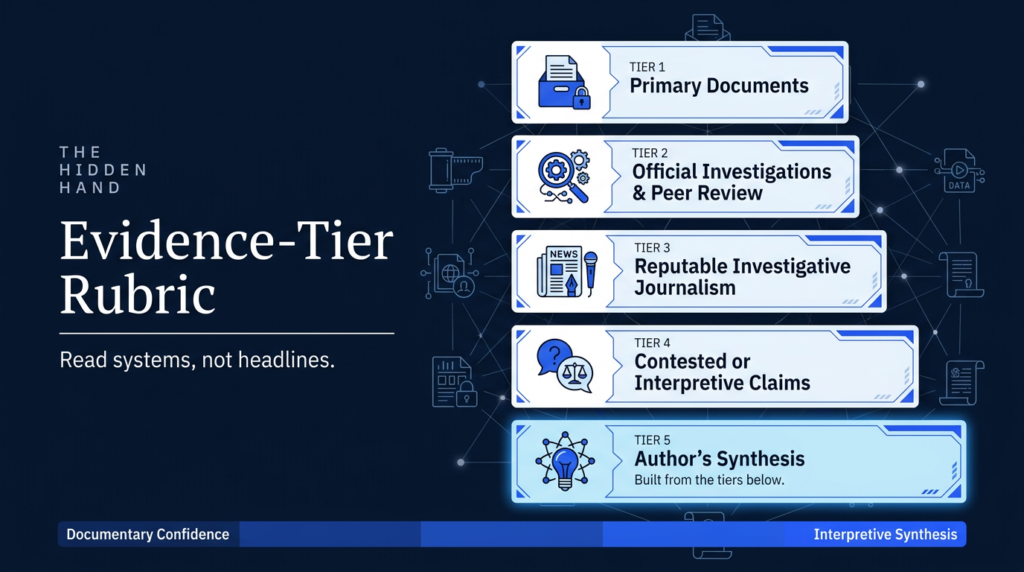
This article applies the same standards-based method outlined in The Hidden Hand Then and Now: A Structural Literacy Framework and the broader research project at The Hidden Hand. Significant claims are labeled by evidence tier where appropriate.
Cloning entered public life wearing a white coat.
For most people, it did not arrive as an argument about power, ownership, or the redesign of life. It arrived as a medical possibility. It came dressed in the language of healing, scientific progress, and compassionate urgency. It was presented as a way to understand disease, repair damaged tissue, improve research, preserve valuable livestock, and perhaps one day help families who could not conceive through ordinary means. [Tier 1][Tier 2]
That framing matters.
When a society is introduced to a controversial capability through the language of relief and rescue, the first boundary that moves is not technical. It is moral. The question stops being, “Should we cross this line at all?” and becomes, “How can we justify crossing it for the right reasons?” That is where cloning became historically significant. Not because the public was first asked to embrace a monstrous future, but because it was first asked to bless a therapeutic one. [Tier 4]
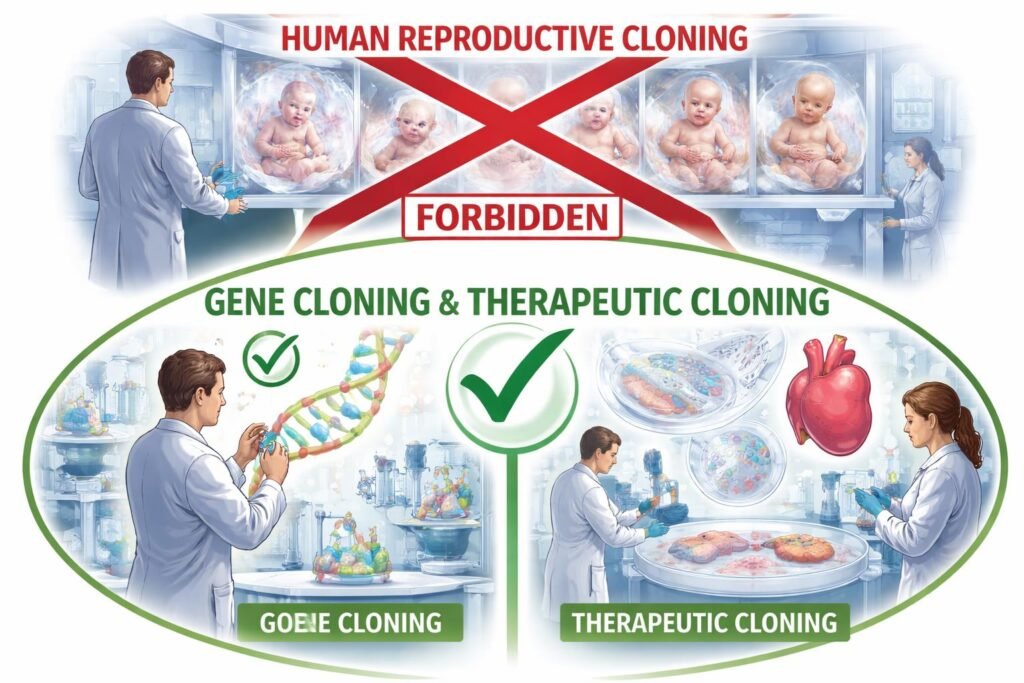
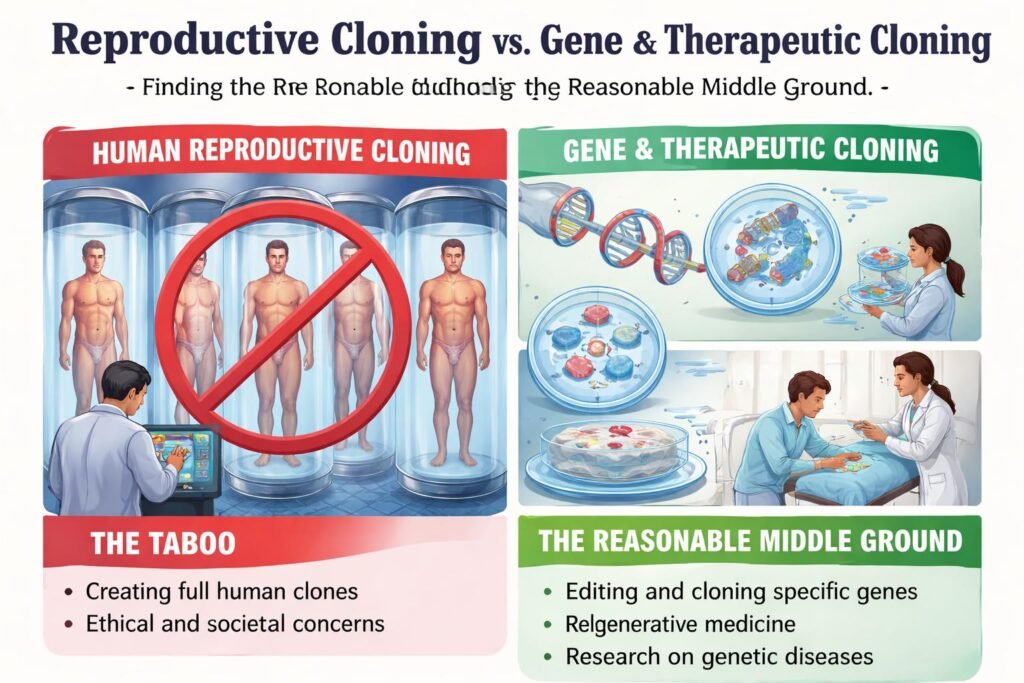
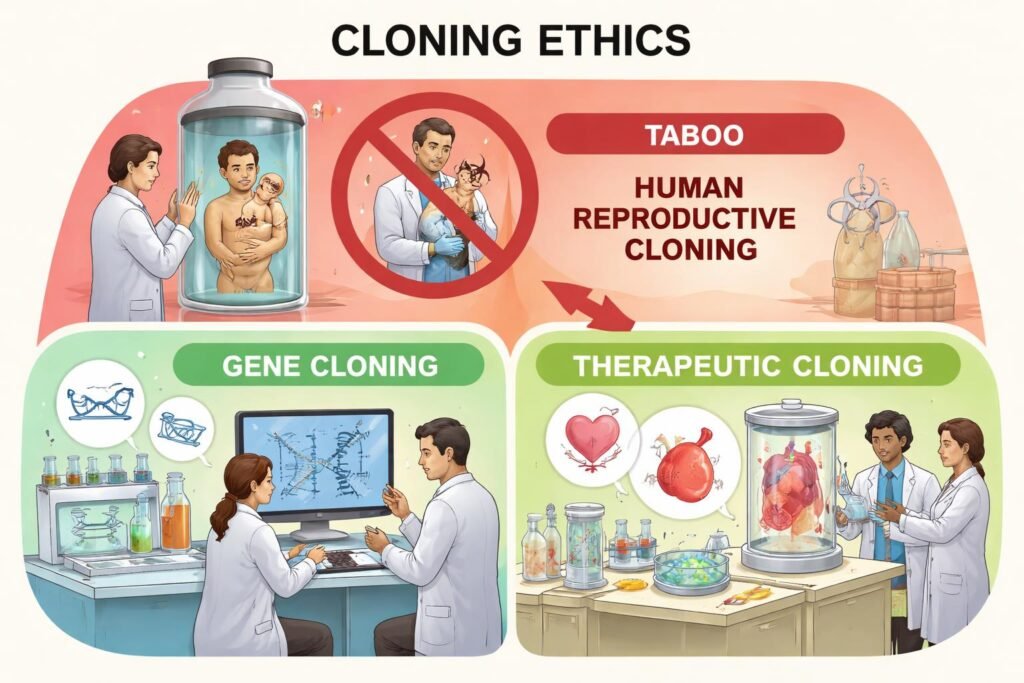
According to the National Human Genome Research Institute’s cloning fact sheet, cloning is not one thing but several related processes, including gene cloning, reproductive cloning, and therapeutic cloning. [Tier 1] That distinction is not a technical footnote. It is the entire opening move in the story. Once cloning is broken into categories, the public is invited to separate the frightening image from the acceptable practice. Human reproductive cloning becomes the taboo. Gene cloning and therapeutic cloning become the reasonable middle ground. [Tier 1][Tier 4]
This was not necessarily deceit. In one sense, it was clarification. But in another sense, it was also a method of normalization.
The mainstream case for cloning was built on practical promises. In medicine, cloning offered the possibility of creating genetically matched cells and tissues that might reduce transplant rejection. It suggested new ways to study disease, test drugs, and eventually support regenerative medicine. [Tier 1][Tier 2]
The National Academies report on the scientific and medical aspects of human reproductive cloning laid out these distinctions in careful terms, especially around somatic cell nuclear transfer and the difference between reproductive cloning and research aimed at generating stem cells for therapeutic use. [Tier 2]
To the public, this sounded like science doing what science claims to do at its best: reduce suffering.
And it was not only medicine. The public-facing rationale extended into agriculture and conservation as well. Cloning could preserve desirable livestock traits, help standardize research animals, and even play a role in efforts to support endangered species. The educational resource Why Clone? from the University of Utah reflects this broader frame clearly.
Cloning appears there not as an act of domination, but as a practical tool for medicine, animal science, and species preservation. That is how the technology was made intelligible to the ordinary reader. It was not framed first as an intrusion into life’s core architecture. It was framed as utility. [Tier 2][Tier 4]
The therapeutic promise, however, always came with shadows that were admitted even in mainstream sources.
The NHGRI fact sheet states plainly that reproductive cloning has been highly inefficient and associated with serious developmental problems in animals, including increased birth size, organ defects, immune problems, and premature aging concerns. Dolly the sheep, the most famous example, was the only live birth from 277 cloned embryos. [Tier 1] In other words, the promise and the peril entered public discussion together. The public was not told there were no risks. It was told the risks were manageable, contained, or outweighed by possible benefit. [Tier 1][Tier 4]
That distinction matters too.
A modern technological society almost never asks for permission in absolute terms. It asks for permission in comparative ones. Not “Is this dangerous?” but “Could this help enough people to justify the danger?” Not “Does this alter the moral boundary?” but “Would it be immoral to deny patients the benefits?” In that environment, resistance begins to look not prudent but callous. [Tier 4]
Therapeutic cloning sharpened the issue even further. Official descriptions emphasized the possibility of producing embryonic stem cells genetically matched to a patient. The logic was compelling. If these cells could be cultivated and directed into tissues, perhaps one could reduce rejection and create more tailored forms of treatment. [Tier 2]
Yet even the same institutional sources acknowledged the ethical cost: therapeutic cloning involves the creation of cloned embryos for research use, and the harvesting of stem cells at the blastocyst stage results in the destruction of the embryo. [Tier 1][Tier 2]
So the real public argument was never simply about science. It was about category management.
What counts as an embryo?
What counts as life?
What counts as a patient?
What counts as material?
Those are not side questions. They are the questions. Once a civilization becomes comfortable discussing early human life primarily in terms of extraction, differentiation, optimization, and therapeutic utility, the vocabulary itself begins to change the ethical field. [Tier 4]
Notice how subtle the shift is. No one needs to announce that life is now raw material. It is enough to discuss certain forms of life as biologically useful inputs within a system of medicine and research. Once that language becomes ordinary, the older moral intuitions do not vanish, but they are pressured from all sides by the promise of cure, access, innovation, and necessity. [Tier 4]
This is why the first article in a series like this must begin with the mainstream case rather than leap immediately to the darkest inference. The stated purpose was real. The therapeutic promise was real. The scientific ambition was real. If one ignores that, one misunderstands how normalization works. Controversial capabilities do not usually enter public life through open declarations of long-range control. They enter through narrow exemptions, compassionate use cases, technical distinctions, and carefully staged reassurance. [Tier 4]
Even the most controversial possibilities in the cloning debate were often buffered by segmentation. Human reproductive cloning was described as dangerous, unethical, and largely off-limits. Research cloning, by contrast, could be discussed as medically serious and morally different because it did not involve implantation in a uterus and was directed toward knowledge or treatment rather than birth. [Tier 2]
This segmentation did not erase ethical conflict. But it did create a managed corridor through which the broader technological framework could continue to advance.
That is the deeper structural significance of cloning’s early public narrative.
The public was not merely being asked what it thought about one experimental technique. It was being asked how it would reason about life under conditions of technological intervention. Would life be treated primarily as inheritance, as dignity, as mystery, as kinship, as gift? Or would life increasingly be approached through the categories of process, programmability, repair, replacement, and managed outcomes? [Tier 4]
By itself, this does not prove a sinister master plan. It does something more sober and more important. It shows how a moral threshold moves in full public view while still being experienced as common sense. That is why cloning belongs inside a structural analysis of modern power. It is not just about the lab. It is about the social conditioning required to make deeper forms of biological governance thinkable.
If you want to understand where this story goes next, do not begin with the loudest claim. Begin with the official rationale. Begin with the humanitarian case. Begin with the institutions saying they are trying to heal, preserve, improve, and save. Then ask a harder question:
What kinds of authority, ownership, and administrative power become easier to establish once life has already been recoded as something that can be copied, cultured, selected, and used?
That is where this series is heading.
The first stage was therapeutic promise.
The next stage is ownership.
Once a capability is normalized as useful, the struggle is no longer only over whether it should exist. The struggle becomes about who funds it, who patents it, who governs it, who profits from it, and who gets to define its acceptable use. That is where the public language of healing begins to merge with the harder architecture of control.
For readers new to this site’s method, that is the key point. Structural analysis does not start by shouting the final conclusion. It starts by taking the official story seriously enough to examine what it authorizes.
And cloning, from the beginning, authorized much more than a scientific procedure. It authorized a new way of reasoning about life itself.
The Structural Synthesis: Beyond the Therapeutic Promise
The official narrative of cloning is built on the promise of “healing,” but a structural analysis of the funding, patents, and institutional momentum suggests a different endgame. When we move from documented intent to a Tier 5 Synthesis, we can see that the therapeutic promise serves as the “soft” entry point for a much harder infrastructure of biological governance.
The “therapeutic” era of cloning has effectively established three critical precedents:
- The Normalization of Biological Fragments: By framing cloning as a search for “stem cells” and “tissues,” the industry has successfully reclassified life as a collection of modular, patentable parts. This removes the “sanctity of the individual” from the legal conversation and replaces it with the “utility of the component.”
- The Architecture of Total Bio-Surveillance: The same technologies required for personalized regenerative medicine, genetic sequencing, cell banking, and synthetic replication are the exact requirements for a state-level biosecurity apparatus. You cannot have “personalized healing” without first giving an institution total data-access to your biological blueprint.
- The Shift from “Born” to “Built”: Structurally, the therapeutic promise is the bridge between the 20th-century model of humans as biological accidents and a 21st-century model of humans as industrial products. Whether it is a lab-grown organ or a replicated cell line, the move toward “therapeutic cloning” is a move toward the absolute management of the human body by external technical systems.
In this light, the “therapeutic promise” is not a lie, but it is a limited truth. Its primary structural function has been to secure public consent and massive capital for an infrastructure that is now capable of much more than just healing. It has built the stage for the next phase of metabolic and reproductive control; a phase that will no longer need the language of “therapy” once the technological capability is fully entrenched.
Internal Links Used in the Article
External Links Used in the Article
- NHGRI Cloning Fact Sheet
- National Academies: Scientific and Medical Aspects of Human Reproductive Cloning
- University of Utah Genetics: Why Clone?
Full Reference List
Internal References
External References
-
National Human Genome Research Institute. Cloning Fact Sheet. U.S. National Institutes of Health.
- Used for definitions of cloning types, animal cloning methods, stated applications, stated risks, and ethical issues.
- Best fit under the site’s rubric: Tier 1 for official institutional documentation.
-
National Academy of Sciences, National Academy of Engineering, Institute of Medicine, and National Research Council. Scientific and Medical Aspects of Human Reproductive Cloning, Chapter 2: Cloning, Definitions and Applications. National Academies Press, 2002.
- Used for the distinction between reproductive cloning and nuclear transfer for stem cell research, stated purposes, and cautions.
- Best fit under the site’s rubric: Tier 2.
-
University of Utah, Learn.Genetics. Why Clone?.
- Used as a supplementary educational overview of the public-facing rationale for cloning in medicine, agriculture, conservation, and pet replication.
- Best fit under the site’s rubric: supportive educational source, used here for explanatory context rather than as the sole basis for a major claim.