
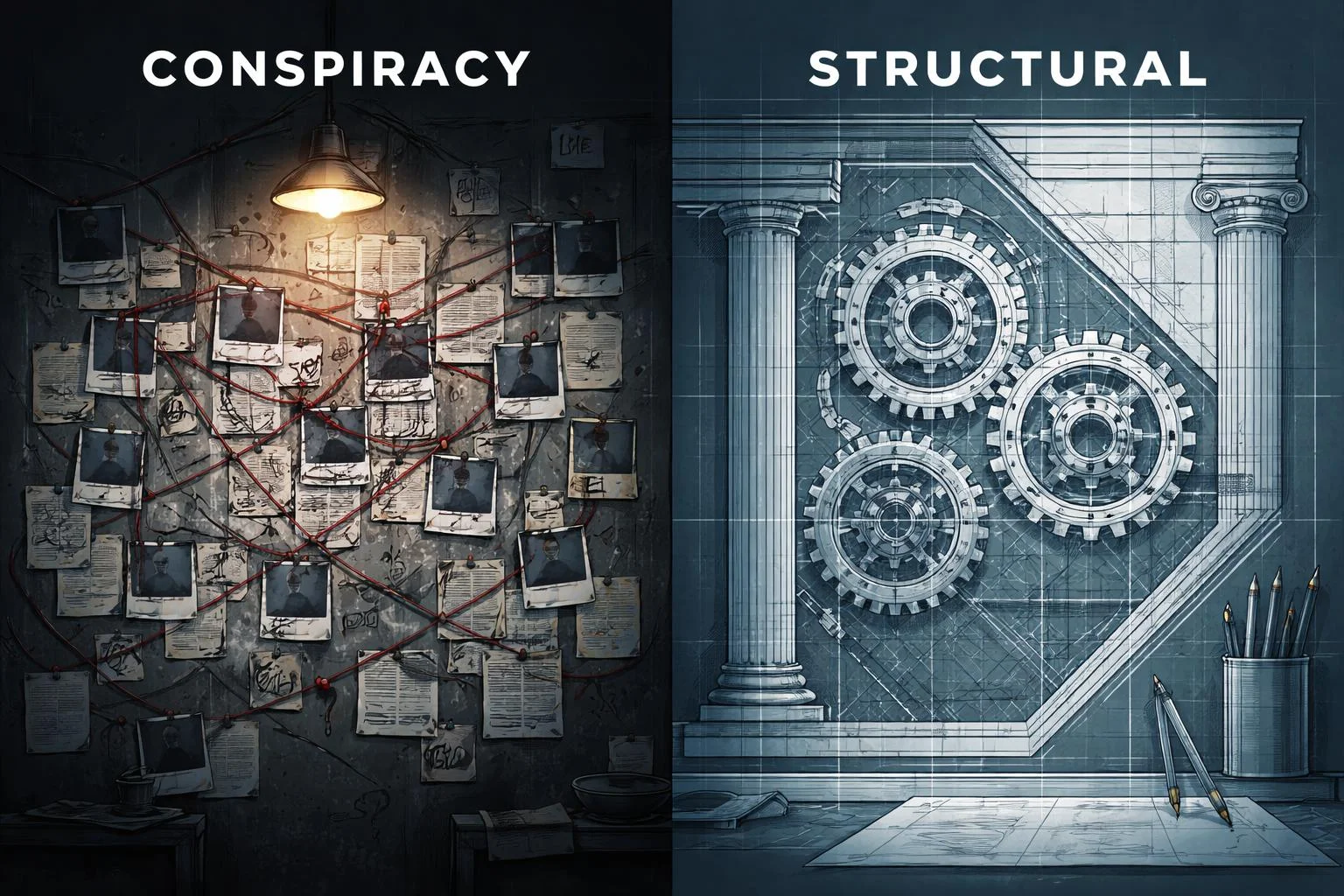
There is a question that quietly shapes almost every serious conversation about power today.
When someone points to patterns of influence, coordinated messaging, or institutional self-interest, are they describing a conspiracy or are they describing a structure?
Most public debate collapses these two things into one. If you question an official narrative, you are labeled a conspiracy theorist. If you accept every official narrative, you are considered reasonable. The middle ground, the most important ground, is rarely named.
That middle ground is structural analysis.
Understanding the difference between a conspiracy claim and a structural analysis is one of the most useful skills a modern reader can develop. It changes how you watch the news, how you evaluate experts, how you read political language, and how you think about your own assumptions. It is also one of the foundational skills inside the Structural Literacy Framework.
The distinction sounds technical. In practice, it is the difference between clear thinking and confused thinking.
Two ways of explaining the world
When something significant happens in politics, finance, media, or public health, people usually reach for one of two explanations.
The first is a conspiracy claim. It says a small group of people met in secret, agreed on a hidden plan, and executed it through covert action. The story is personal, intentional, and dramatic. It depends on specific actors doing specific things behind closed doors.
The second is a structural analysis. It says certain outcomes are produced not by secret meetings, but by the way a system is built. Incentives, rules, ownership patterns, funding flows, career pipelines, regulatory capture, and information architecture all push behavior in predictable directions. No central plotter is required. The structure itself does the work.
Both explanations can sometimes apply to the same event. Real conspiracies do happen, and many have been documented in court records, congressional hearings, and declassified files. The U.S. Senate’s Church Committee reports on intelligence abuses and the Department of Justice’s antitrust cases on price fixing are obvious examples. But most of what shapes daily life is not a conspiracy at all. It is a structure.
The mistake is treating these two categories as if they were the same thing.

What a conspiracy claim usually looks like
A conspiracy claim, in its most common form, has several features.
It centers on hidden actors. It assumes coordinated intent. It often relies on insider knowledge, leaked documents, anonymous sources, or speculative connections. It tends to focus on personalities rather than systems. It frequently presents itself as the secret truth that mainstream media is hiding.
Some conspiracy claims turn out to be accurate. History is full of plots that were dismissed at the time and confirmed later, from COINTELPRO to MKUltra to corporate cover-ups exposed through litigation. Skepticism toward power is not the problem.
The problem appears when a claim has the shape of a conspiracy theory without the substance of one. That is, when it asserts hidden coordination but cannot show:
- who specifically coordinated,
- when and where they did so,
- through what mechanism,
- with what evidence beyond pattern recognition.
Without those elements, a conspiracy claim is mostly a feeling dressed up as an explanation. It may capture a real intuition that something is wrong, but it does not yet name what is actually happening.
This is where many people get stuck. They sense that the official story is incomplete, but the only alternative they have been given is the language of conspiracy. So they reach for it, even when a more accurate framework is available.
That more accurate framework is structural analysis.
What a structural analysis actually does
A structural analysis does not begin with hidden actors. It begins with visible architecture.
It asks a different set of questions:
- Who owns this institution?
- Who funds it?
- Who regulates it, and who used to work there?
- What are the career incentives for people inside it?
- What gets rewarded, and what gets punished?
- What information flows in, and what gets filtered out?
- Whose interests are protected by the current rules, and whose are not?
These are not secret questions. The answers are usually available in public filings, regulatory disclosures, ownership records, lobbying databases, peer-reviewed studies, and investigative reporting. Tools like OpenSecrets, ProPublica, and the Government Accountability Office exist precisely so citizens can read structure rather than guess at it.
A structural analysis does not need a villain. It needs a map.
When you map the structure of an industry, a media ecosystem, a regulatory body, or a political party, you start to see why certain outcomes keep repeating even when the personalities at the top change. Different administrations, different CEOs, different anchors, and the same patterns hold. That recurrence is the signature of structure.
This is why structural literacy is more powerful than conspiracy thinking. It explains continuity. Conspiracies require constant new actors. Structures keep producing similar outcomes for decades.

The same event, two different lenses
Consider a familiar example: a major financial crisis followed by a wave of bailouts and new regulations that quietly favor the largest institutions.
A conspiracy claim might say a small group of bankers and officials secretly engineered the crisis to consolidate power.
A structural analysis would say something different.
It would point to the revolving door between major banks and financial regulators, documented in years of public records. It would note how lobbying spending shifts before and after legislation, traceable through OpenSecrets and the Senate’s lobbying disclosure database. It would examine which firms qualify as “systemically important” and which do not, and how that designation alters their access to credit and political influence. It would track how complex regulations tend to favor institutions large enough to afford armies of compliance lawyers.
Notice what changes.
The structural analysis does not require a secret meeting. It does not need anyone to be a cartoon villain. It simply describes a system in which the largest players are positioned to benefit from crises, almost regardless of intent. The outcome is not an accident, but it is also not a plot. It is the natural product of how the structure is built.
That is a much harder story to dismiss. It is also a much harder story to tell, which is why so many public conversations default to the simpler conspiracy frame instead.
Why the distinction matters
The difference between a conspiracy claim and a structural analysis is not just academic. It changes what you can see, what you can prove, and what you can do.
Conspiracy thinking, when it dominates, tends to produce three problems.
First, it personalizes systemic issues. If everything is the fault of a hidden cabal, then changing the cabal seems like the solution. The deeper architecture goes untouched.
Second, it makes serious analysis easier to discredit. Once a topic gets associated with conspiracy framing, mainstream institutions can dismiss any inquiry into it, even careful and well-documented inquiry. The label does the work of refutation.
Third, it traps the audience emotionally. Conspiracy narratives often deliver a sense of secret knowledge and moral clarity. That feeling can be addictive. It can also crowd out the slower, more disciplined work of reading structure.
Structural analysis, by contrast, is harder emotionally and easier evidentially. It does not promise hidden truths. It promises visible patterns. It asks you to read filings, follow money, study incentives, and notice what keeps repeating across administrations and decades.
It is less thrilling. It is also far more accurate.

How official discourse blurs the line on purpose
Part of the reason this distinction is so hard to maintain is that powerful institutions benefit when it stays blurry.
If any criticism of a major industry, agency, or narrative can be flagged as “conspiracy theory,” then structural analysis becomes nearly impossible to conduct in public. Legitimate questions about ownership, funding, regulatory capture, and information control get pre-discredited. The label is used not to refute the argument, but to prevent it from being heard.
You can see this dynamic in coverage of topics like media consolidation, pharmaceutical regulation, intelligence community influence in newsrooms, and the financial ties between think tanks and the policies they promote. When researchers cite documented relationships and public filings, they are often lumped in with people making wild, unsupported claims. The two are then dismissed together.
This is itself a structural pattern. It is not necessarily coordinated, but it is reliably produced by the incentives of mainstream media, political parties, and institutional gatekeepers. The blurring of conspiracy and structural analysis serves a function. It protects the system from scrutiny without requiring anyone to engage with the actual evidence.
Recognizing that pattern is itself an act of structural literacy.
A simple test you can use
When you encounter a claim about how power operates, you can quickly sort it using a few questions:
- Does the claim depend on hidden actors or on visible architecture?
- Is the evidence drawn from public records, filings, regulations, and documented relationships, or from speculation about secret meetings?
- Does the explanation still hold even if no one involved had bad intentions?
- Does it explain why the same patterns keep appearing across different leaders, parties, and decades?
- Could a careful researcher reproduce the analysis using open sources?
If the answer to most of these is yes, you are probably looking at a structural analysis, even if it sounds uncomfortable or politically inconvenient.
If the answer is mostly no, and the argument depends almost entirely on hidden coordination that cannot be shown, you are probably looking at a conspiracy claim, whether or not it eventually turns out to be true.
This test is not about closing your mind to the possibility of real plots. It is about keeping the categories clean. Real conspiracies should be investigated with evidence. Structural patterns should be analyzed with maps. Mixing the two confuses both.
Where structural literacy fits in
Structural literacy is not the opposite of skepticism. It is skepticism with a method.
It assumes that power is real, that institutions have interests, that incentives matter, and that systems shape outcomes more than individuals do. It also assumes that most of what we need to understand about modern power is not hidden in a vault. It is sitting in plain sight, waiting to be read by people who know what to look for.
This is the orientation behind the work at The Hidden Hand and the broader project described on the About page. The goal is not to chase shadows. It is to teach a way of reading reality that does not depend on either blind trust or secret-knowledge thinking.
When you start applying structural analysis consistently, several things happen.
You stop being surprised by predictable outcomes. You stop personalizing systemic problems. You become harder to manipulate with both official narratives and sensational counter-narratives. You start to see the news as a layer on top of deeper currents, rather than as the full story.
You also become much harder to dismiss. A person who can cite ownership structures, funding flows, regulatory histories, and documented incentives is not making a conspiracy claim. They are doing the work that serious journalism, political science, and economic analysis used to do as a matter of course.
That work is exactly what is being rebuilt, piece by piece, in the structural literacy tradition.

The deeper lesson
The deeper lesson is simple. Most of the patterns that shape your life are not the result of secret plots. They are the result of structures that reward certain behaviors and punish others, that concentrate certain kinds of power and disperse certain kinds of risk, that filter information in ways most people never notice.
You do not need a hidden meeting to explain why these patterns persist. You need a clear map of the system that produces them.
Conspiracy claims, on their own, rarely give you that map. They often distract from it. They focus attention on shadowy figures while the real architecture goes unexamined.
Structural analysis is harder, slower, and less dramatic. It is also far more useful. It allows you to describe how power actually operates without losing your grip on evidence, and without surrendering your skepticism to the official version of events.
That is the orientation this site is built around. Not conspiracy. Structure.
Once you can tell the difference, you can never quite read the news the same way again.
Conclusion
A conspiracy claim asks who is secretly pulling the strings. A structural analysis asks how the strings are arranged in the first place.
Both questions can be useful at the right moments. But only one of them gives you a durable map of how modern power works.
In a media environment that constantly pushes you toward either blind trust or sensational suspicion, the disciplined middle path is structural literacy. It refuses to pretend the system is innocent. It also refuses to invent villains where structures are sufficient to explain the outcome.
That is the kind of analysis serious readers need. And it is the kind this site is committed to building, one pattern at a time.
If you have not yet read its companion piece, How a Public Narrative Is Built Before the Evidence Arrives, it pairs naturally with this one. Together they offer a starting toolkit for reading modern power without falling into either naive trust or unfounded suspicion.
External Links Used (for editorial reference)
- U.S. Senate Select Committee on Intelligence — Historical Commissions
- U.S. Department of Justice — Antitrust Case Filings
- COINTELPRO — Overview
- MKUltra — Overview
- OpenSecrets — Money in Politics
- ProPublica — Investigative Journalism
- U.S. Government Accountability Office
- Revolving Door in Politics — Overview
- U.S. Senate Lobbying Disclosure Database
- Pew Research Center — Journalism and Media