

When a major story breaks, most people experience it the same way.
A phone lights up. A headline flashes across a screen. Someone posts a clip. A friend texts, “Did you see this?” Within minutes, a thousand opinions are already circulating. Within an hour, people are not just reacting to an event. They are reacting to a story about the event.
That story often arrives before the facts do.
This is one of the most important things to understand about modern media. In fast moving moments, the public usually does not receive evidence first and interpretation second. We get the frame first. We get the language first. We get the emotional tone first. Then, much later, we may get the fuller picture.
By then, the narrative has already done its work.
This does not always happen because of some secret meeting in a dark room. Often it happens because modern information systems reward speed, certainty, and emotional clarity. Newsrooms need a hook. Social platforms reward engagement. Political actors rush to define the moment before their rivals do. Experts are called in before the basic facts are settled. Audiences want answers while the evidence is still incomplete.
The result is familiar. A public narrative forms quickly, spreads widely, and hardens early.
If you want to understand how public opinion is shaped, you have to understand this process. It is one of the core skills inside the Structural Literacy Framework.
The first frame is usually the most powerful
In the opening hours of a big story, there is usually very little verified information. Witnesses may be mistaken. Video clips may be partial. Official statements may be incomplete. Early reports often conflict with one another. Research from the Reuters Institute for the Study of Journalism consistently shows that audiences form lasting impressions from initial coverage, even when later reporting revises the story.
Yet this is the exact moment when the strongest claims are often made.
Why? Because the first frame has enormous power.
The first frame tells people what kind of story they are looking at. Is it a tragedy? A scandal? A failure? A threat? A crime? A warning? A moral test? Once that frame is in place, most of what follows gets filtered through it. This effect was described decades ago by sociologist Erving Goffman in his work on frame analysis, and it has only intensified in the digital era.
People do not just remember facts. They remember meaning. They remember how they were told to interpret what they saw.
This is why the earliest language matters so much. A single adjective can tilt perception. A phrase can narrow the range of acceptable conclusions. A headline can make one explanation feel obvious before alternatives have even been considered.
In other words, the public narrative does not begin when all the facts are known. It begins when the first persuasive version of events becomes socially dominant.
Speed beats caution in the modern attention economy
In theory, caution should win in uncertain moments. In practice, speed usually wins.
A journalist who says, “We do not yet know enough,” may be accurate, but accuracy is rarely as viral as certainty. A commentator who says, “This is exactly what happened and here is what it means,” is more likely to capture attention, even if the evidence is thin. A widely cited MIT study published in Science found that false news stories spread significantly faster and farther on social media than accurate ones, largely because they tend to be more novel and emotionally charged.
Social media makes this even more intense. The first people to frame a story often gain the most reach. Their posts get quoted, clipped, reposted, and embedded into the wider conversation. By the time slower and more careful reporting appears, the emotional structure of the story may already be set.
This is not just a media problem. It is a human problem.
Most people do not like ambiguity. In moments of uncertainty, we naturally look for a clean explanation. We want the chaos to become legible. We want a villain, a motive, a moral lesson, a takeaway.
Narratives satisfy that need.
Evidence often complicates it.
Official sources have a built-in head start
When a major event happens, official institutions often become the first recognized source of information. Government agencies, police departments, intelligence officials, corporate spokespeople, and major public figures all enter the story early. Media scholars have long described this dynamic as indexing theory, the tendency of mainstream coverage to track the range of debate among official elites rather than the broader public.
That does not mean every official claim is false. It does mean official claims have structural advantages.
They arrive quickly. They sound authoritative. They are easy for reporters to quote. They give media organizations something solid-looking to publish while facts are still emerging.
Once official language enters the stream, it can shape coverage far beyond the original statement. Journalists repeat it. Analysts interpret it. Headlines compress it. Social media users react to it. Soon the public is not simply discussing the event. The public is discussing the official framing of the event.
This matters because early institutional narratives often set the boundaries of what feels plausible. Questions outside that frame may be treated as fringe, irresponsible, or unnecessary long before the evidence has been fully examined.
The key point is simple. The first version of a story is often not the truest version. It is the version with the strongest distribution.

Repetition creates the feeling of truth
There is a moment in almost every major news cycle when a phrase starts appearing everywhere.
You see it in headlines. You hear it in interviews. You notice it in social media posts, expert panels, and casual conversation. The phrase may be simple, even vague, but that is part of its power. It is easy to remember and easy to repeat.
Repetition does something important to the mind. It makes an idea feel settled. Psychologists call this the illusory truth effect, the well-documented tendency for people to rate repeated statements as more likely to be true, regardless of their accuracy.
Most people do not have time to investigate every major story for themselves. They rely on signals. If the same interpretation appears across many outlets, many accounts, and many voices, it begins to feel like consensus. And consensus feels a lot like truth.
But repetition is not proof. It is often just amplification.
A claim repeated one hundred times is still only as strong as the evidence behind it. Yet in the real world, repetition often stands in for verification. The public starts to confuse familiarity with accuracy.
This is one reason narrative formation can be so powerful. Once a frame becomes common language, challenging it can feel socially costly even if important evidence is still missing.
Emotion is not a side effect. It is part of the delivery system
Public narratives spread fastest when they attach themselves to emotion.
Fear, outrage, grief, disgust, urgency, and moral clarity all help a story travel. Emotion turns information into something people feel compelled to share. It lowers the threshold for reaction and raises the pressure to take sides. Research on moral-emotional language on social media shows that each emotionally charged word in a political message can measurably increase how far it spreads.
This is especially true during breaking news. If a story is introduced with a strong emotional charge, many people will absorb the mood before they absorb the facts.
That mood shapes judgment.
A frightened public asks different questions than a calm public. An angry public accepts different policies than a patient public. A morally inflamed public has less tolerance for uncertainty, nuance, or procedural fairness.
Again, this does not require a grand conspiracy. It is often built into how media works. Emotional stories outperform cautious ones. Platforms reward content that triggers immediate reaction. Political actors understand that a feeling can move faster than a document.
If you want to know why narratives harden so quickly, look not only at the claims being made, but also at the emotions attached to them.
Experts arrive before the evidence is settled
Another familiar pattern appears early in the cycle. Experts are brought in to explain what the event means.
Sometimes this is useful. Sometimes it is necessary. But it also changes the public conversation in a subtle way.
Instead of asking, “What do we know?” the conversation shifts to, “What should we conclude?”
That is a very different question.
Experts can help interpret facts, but in fast moving situations they are often interpreting partial facts, filtered facts, or official summaries of facts. Their role can give an unsettled story the appearance of intellectual closure. The Pew Research Center has documented how heavy reliance on a narrow pool of pundits and analysts during breaking events tends to compress, rather than expand, the range of interpretation offered to the public.
This is especially powerful when expert commentary aligns with the first institutional frame. The public now hears the same interpretation from officials, media hosts, and credentialed analysts. The narrative begins to feel not only common, but professionally validated.
By the time contradictory evidence appears, many people are no longer evaluating facts from scratch. They are defending a story they have already learned to trust.

Corrections rarely catch up to first impressions
Later, the story may change.
New footage may emerge. Witness accounts may be revised. Documents may complicate the original claim. Quiet corrections may appear. Details once treated as certain may become doubtful.
But public memory does not reset so easily. Studies on the continued influence effect show that misinformation often shapes people’s reasoning long after a correction, even when they consciously accept that the original claim was wrong.
The first narrative usually reaches the largest audience with the strongest emotional impact. Later corrections are often smaller, drier, and less widely shared. They arrive after attention has moved on. They also require something difficult from the audience: the willingness to revisit a settled impression.
Many people never do.
That is why first impressions matter so much in media framing. Even when the record changes, the original story often lingers in public consciousness. It becomes the version people remember, quote, and build on.
In this sense, narrative power is front loaded. Early framing does not have to be perfect to be effective. It just has to arrive first, sound coherent, and spread faster than competing interpretations.
How to protect your mind in the first 24 hours
If public narratives are often built before the evidence arrives, what can ordinary people do about it?
The answer is not cynicism. It is discipline. Organizations like the News Literacy Project and First Draft’s verification resources offer practical tools for slowing down and pressure-testing breaking stories before reacting to them.
When a major story breaks, resist the pressure to reach immediate certainty. Notice the framing before you debate the facts. Ask what is being asserted, what is being assumed, and what is still unknown.
A few simple questions can change the way you read the news:
- What do we actually know right now?
- Which claims are verified, and which are interpretations?
- Who introduced the dominant frame first?
- What language is being repeated across outlets?
- What emotions are being activated?
- What possibilities are being ignored because the story already feels settled?
- If new evidence contradicts this early narrative, will most people ever see it?
These questions do not make you paranoid. They make you attentive.
In a media system built for speed, attention is a form of independence.

The deeper lesson
The deeper lesson is not that every narrative is false. It is that narratives are powerful because they organize uncertainty before the evidence is complete.
They tell the public where to look, how to feel, and what kind of explanation already counts as reasonable. They shape memory before the record stabilizes. This is exactly the kind of pattern explored across the work at The Hidden Hand and in the About page, where the focus is structure, not personality.
That is why structural media literacy matters so much today. If you cannot recognize how a public narrative is built, you will keep mistaking early framing for established truth.
And once that happens, you are no longer simply observing the news.
You are living inside a story someone else assembled in real time.
The next time a major headline explodes across every screen, pause before joining the chorus. The most important part of the story may not be what happened. It may be how quickly everyone was told what it meant.
Conclusion
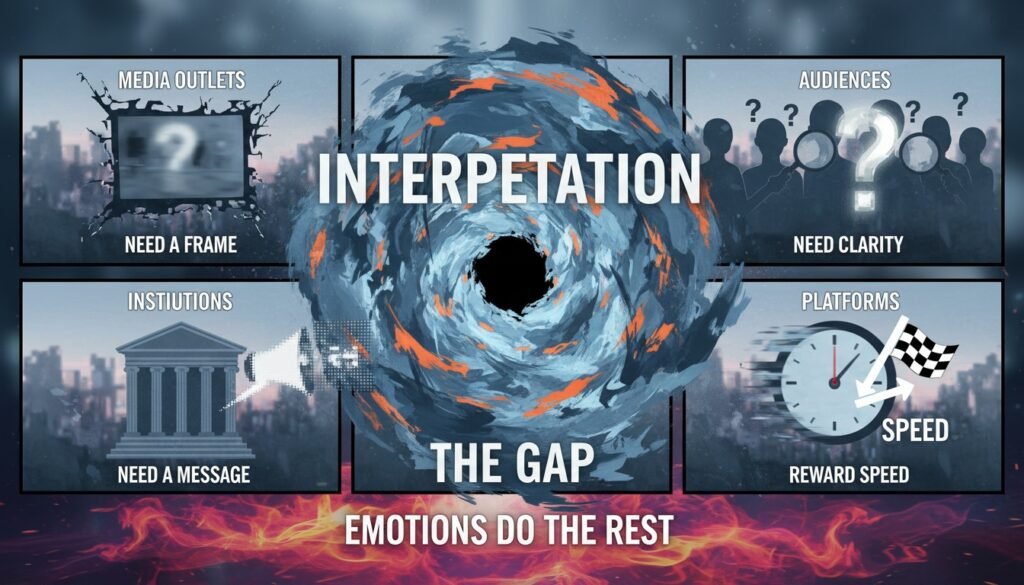
Before evidence arrives, interpretation rushes in to fill the gap. Media outlets need a frame. Institutions need a message. Audiences need clarity. Platforms reward speed. Emotions do the rest.
That is how a public narrative is built.
The process is not always coordinated, but it is often predictable. First comes the event. Then comes the frame. Then the repetition. Then the emotional lock-in. Then, much later, the evidence struggles to catch up.
If we want a healthier public culture, we need to get better at seeing that sequence clearly. We need to learn the difference between information and framing, between evidence and momentum, between what is known and what is merely being made to feel undeniable.
Because in modern media, the battle for public understanding is often decided long before the facts are fully on the table.
External Links Used (for editorial reference)
- Reuters Institute for the Study of Journalism — Research
- Frame Analysis (Erving Goffman) — Overview
- MIT study on the spread of false news in Science
- Indexing theory in political communication
- Illusory truth effect
- Moral-emotional language and social media diffusion (PNAS)
- Pew Research Center — Journalism and Media
- Continued influence effect
- News Literacy Project
- First Draft — Verifying Online Information