
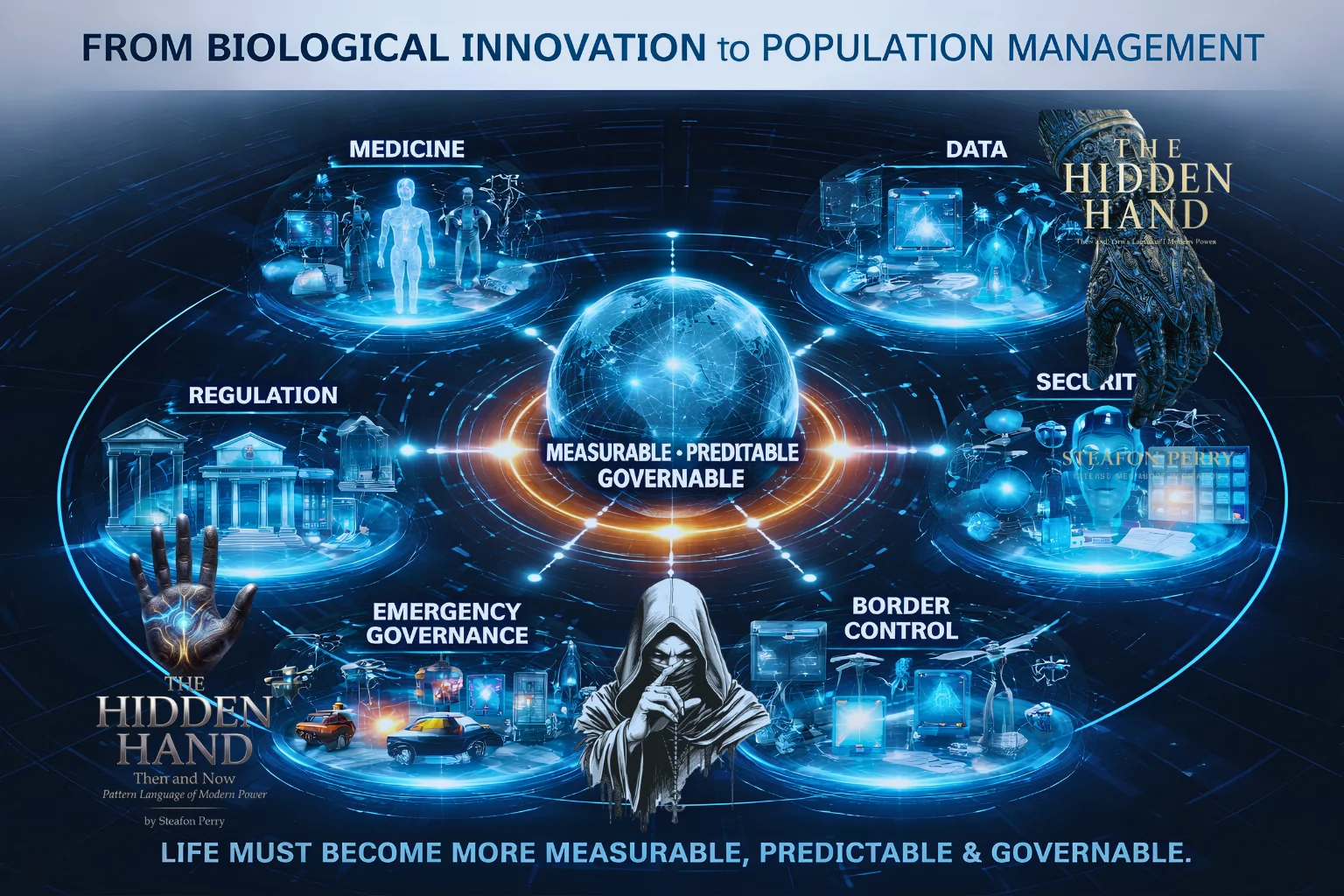
There is a moment, if you have followed this series from the beginning, when the pieces stop looking separate.
Cloning looked like medicine.
Biosecurity looked like protection.
Emergency measures looked temporary.
Data systems looked administrative.
Funding streams looked technical.
Ethics boards looked reassuring.
Each one arrived wrapped in its own language, its own experts, its own institutional justifications. Each one was introduced as a narrow answer to a narrow problem. Healing. Safety. Preparedness. Efficiency. Resilience.
But structural literacy asks a harder question.
It asks what happens when you stop looking at these systems one by one and start looking at the direction they are all moving together.
That is where the larger picture begins.
Not Conspiracy. Structure.
This series has never argued that every scientist is malicious, that every institution is secretly coordinating every outcome, or that every biotech advance conceals a monstrous purpose. That is the wrong level of analysis. The point is not to replace evidence with fantasy. The point is to notice that, over time, different sectors often move in the same direction. Medicine, data, security, border management, regulation, and emergency governance increasingly converge around a single organizing principle: life must become more measurable, more predictable, more governable, and more administratively legible.
That is the pattern.
It is also why the real issue is not cloning alone.
Cloning matters because it opens a door. It reframes life from inheritance into manufacture, from mystery into process, from relation into technique. It introduces the possibility that biological existence can be selected, copied, optimized, stored, patented, and governed inside technical systems. Even where cloning itself remains limited, controversial, or tightly regulated, the worldview it helps normalize does not disappear. It spreads into adjacent fields: reproductive technology, stem cell science, tissue engineering, genetic intervention, biosurveillance, synthetic biology, and public health infrastructure.
The question is not whether every one of these fields is identical. The question is what kind of civilization they are helping build together.
The Architecture of Managed Life
A useful place to start is the language of biosecurity itself. As one scientific review put it, biosecurity increasingly operates as an integrated framework linking human, animal, plant, and environmental health into a unified field of management rather than a series of isolated domains.
In One Biosecurity: a unified concept to integrate human, animal, plant, and environmental health, the argument is explicit: effective governance now depends on bringing formerly separate sectors into coordinated systems of risk assessment, control, and response. That may sound prudent. Structurally, it also means that more and more of life enters a common grid of administrative visibility.
That shift matters.
Once life is understood primarily through the lens of risk, the population ceases to be a community in the civic sense and becomes a field to be monitored, sorted, nudged, protected, and managed. The individual is still spoken to as a citizen, consumer, or patient. But institutionally, the person appears as a data point within a larger probabilistic system.
You can see this logic in the pandemic era. The BMJ’s reporting on England’s Joint Biosecurity Centre describes a public health apparatus explicitly modeled on a counterterror structure. The center was designed to aggregate data, detect outbreaks, advise on alert levels, and coordinate response across systems. None of that proves a hidden master plan. It does show the growing fusion of health governance, security frameworks, and real-time population analysis.
You can see the same tendency in border policy. The study Covidfencing effects on cross-border deterritorialism: the case of Europe describes how pandemic management rapidly transformed movement, territory, and cross-border life. Under crisis conditions, population flow could be paused, filtered, and reorganized with remarkable speed. That is not only a story about disease. It is a story about how quickly modern institutions can redraw the lived map of everyday life when a biological rationale is in place.
And you can see the same pattern inside funding and risk governance. Recent guidance for assessing biosecurity and biosafety risks in research proposals prior to funding shows how deeply biological research is now embedded in systems of screening, mitigation, institutional review, and anticipatory control. The research may be justified by public benefit. The governing logic is unmistakable: identify risk early, classify it, monitor it, and determine which forms of life science are acceptable to advance under which conditions.
That is the architecture of managed life.
This is why the population question cannot be dismissed as fringe, even if it is often framed badly. Historically, states and powerful institutions have always thought in demographic terms. They have concerned themselves with birth rates, labor supply, military fitness, disease, disability, migration, reproduction, and social order. Sometimes this took crude forms, such as eugenics.
Sometimes it took bureaucratic forms, such as census regimes, sanitation systems, family policy, and public health interventions. Sometimes it took economic forms, such as labor planning and actuarial governance. The language changed. The impulse remained.
The strongest version of the argument is not that a document exists somewhere proving a single secret depopulation plot. The strongest version is that modern power routinely approaches human beings at scale through categories of utility, risk, cost, burden, productivity, and compliance. Once that happens, the moral center of governance subtly shifts. People are no longer only ends in themselves. They become variables in a system that must be stabilized.
That is where cloning re-enters the story.
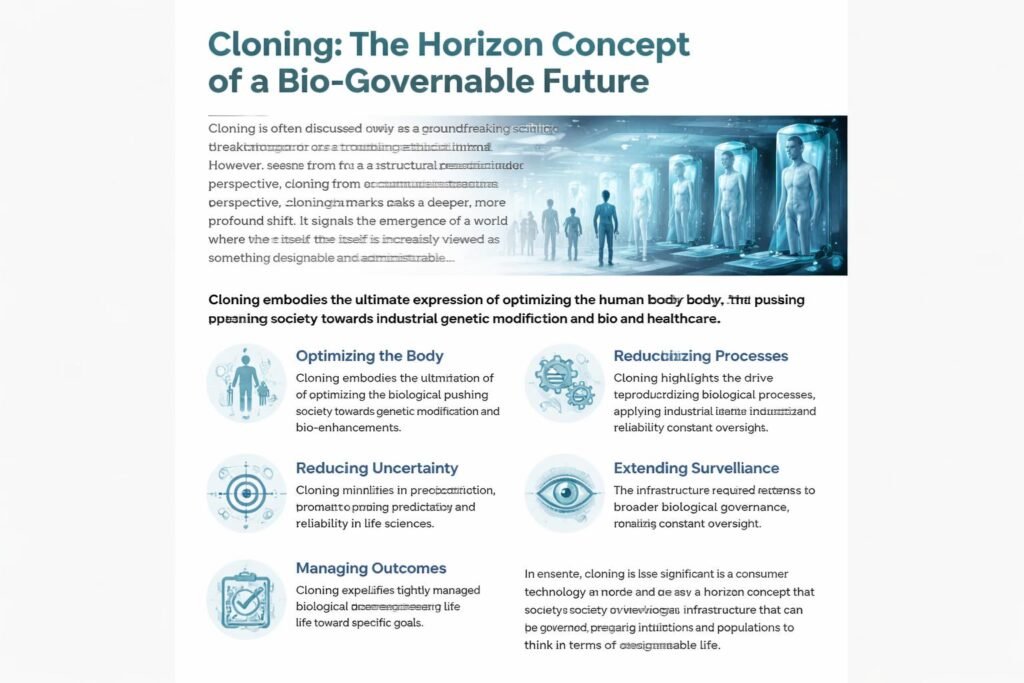
Cloning is often discussed as a scientific question or an ethical boundary case. But in structural terms, it marks a deeper transformation. It signals a world in which life can increasingly be approached as something designable and administrable. Even if full human cloning never becomes normalized, the mentality associated with it can still permeate society: optimize the body, standardize the process, reduce uncertainty, improve control, extend surveillance, and manage outcomes.
In that sense, cloning is less important as a mass consumer product than as a horizon concept. It helps teach institutions and populations alike to think of biology as governable infrastructure.
This is also where the language of replacement deserves care. If we use the word recklessly, it sounds cartoonish. But if we use it structurally, it becomes more precise.
The replacement may not first be biological. It may be political and cultural.
The unquantified person is replaced by the measurable subject.
The citizen is replaced by the managed population unit.
Local judgment is replaced by system protocol.
Embodied relation is replaced by mediated compliance.
Moral agency is replaced by authorized guidance.
Public deliberation is replaced by emergency administration.
Once those substitutions are accepted, more literal biological interventions become easier to justify because the conceptual ground has already shifted. A society that has learned to see itself primarily through dashboards, threat levels, predictive models, and optimized outcomes is already halfway into a different anthropology. It has begun to understand human life less as a moral and civic mystery and more as an object of calibrated governance.
This is why the quieter cultural material matters, even if only as supporting texture. The modern world has repeatedly staged infancy, vulnerability, and managed life as spectacle and commerce. From incubator exhibitions in the early twentieth century to the merchandising of idealized childhood, the culture has long rehearsed a strange intimacy between care, display, commerce, and biological management.
Those episodes do not prove later biotech agendas. They do suggest that modern societies are more comfortable than they admit with placing life inside systems of curation, mediation, and ownership.
The same applies to suspicious research and funding patterns. Follow the money, and the picture becomes less mystical and more concrete. Which projects are accelerated? Which applications receive legitimacy? Which risks are tolerated? Which ethical boundaries soften under the pressure of security, profit, or urgency? Those questions do not require conspiracy thinking.
They require institutional literacy. As The Hidden Hand’s Structural Literacy Framework makes clear, the issue is not whether power exists. The issue is whether we can read the mechanisms through which it operates.
The Population Question
This is why the population question cannot be dismissed as fringe, even if it is often framed badly.
Historically, states and powerful institutions have always thought in demographic terms. They have concerned themselves with birth rates, labor supply, military fitness, disease, disability, migration, reproduction, and social order. Sometimes this took crude forms, such as eugenics programs. Sometimes it took bureaucratic forms, such as census regimes, sanitation systems, family policy, and public health interventions. Sometimes it took economic forms, such as labor planning and actuarial governance. The language changed. The impulse remained.
The strongest version of the argument is not that a document exists somewhere proving a single secret depopulation plot. The strongest version is that modern power routinely approaches human beings at scale through categories of utility, risk, cost, burden, productivity, and compliance. Once that happens, the moral center of governance subtly shifts. People are no longer only ends in themselves. They become variables in a system that must be stabilized.
That is where cloning re-enters the story.
Cloning is often discussed as a scientific question or an ethical boundary case. But in structural terms, it marks a deeper transformation. It signals a world in which life can increasingly be approached as something designable and administrable. Even if full human cloning never becomes normalized, the mentality associated with it can still permeate society: optimize the body, standardize the process, reduce uncertainty, improve control, extend surveillance, and manage outcomes.
In that sense, cloning is less important as a mass consumer product than as a horizon concept. It helps teach institutions and populations alike to think of biology as governable infrastructure.
The Quieter Replacement
This is also where the language of replacement deserves care. Used recklessly, it sounds cartoonish. Used structurally, it becomes precise.
The replacement may not first be biological. It may be political and cultural.
The unquantified person is replaced by the measurable subject.
The citizen is replaced by the managed population unit.
Local judgment is replaced by system protocol.
Embodied relation is replaced by mediated compliance.
Moral agency is replaced by authorized guidance.
Public deliberation is replaced by emergency administration.
Once those substitutions are accepted, more literal biological interventions become easier to justify because the conceptual ground has already shifted. A society that has learned to see itself primarily through dashboards, threat levels, predictive models, and optimized outcomes is already halfway into a different anthropology. It has begun to understand human life less as a moral and civic mystery and more as an object of calibrated governance.
This is why the quieter cultural material matters, even if only as supporting texture. The modern world has repeatedly staged infancy, vulnerability, and managed life as spectacle and commerce. From incubator exhibitions at the turn of the twentieth century to the merchandising of idealized childhood, the culture has long rehearsed a strange intimacy between care, display, commerce, and biological management. Those episodes do not prove later biotech agendas. They do suggest that modern societies are more comfortable than they admit with placing life inside systems of curation, mediation, and ownership.
The same applies to suspicious research and funding patterns. Follow the money, and the picture becomes less mystical and more concrete. Which projects are accelerated? Which applications receive legitimacy? Which risks are tolerated? Which ethical boundaries soften under the pressure of security, profit, or urgency? Those questions do not require conspiracy thinking. They require institutional literacy. As The Hidden Hand’s Structural Literacy Framework makes clear, the issue is not whether power exists. The issue is whether we can read the mechanisms through which it operates.
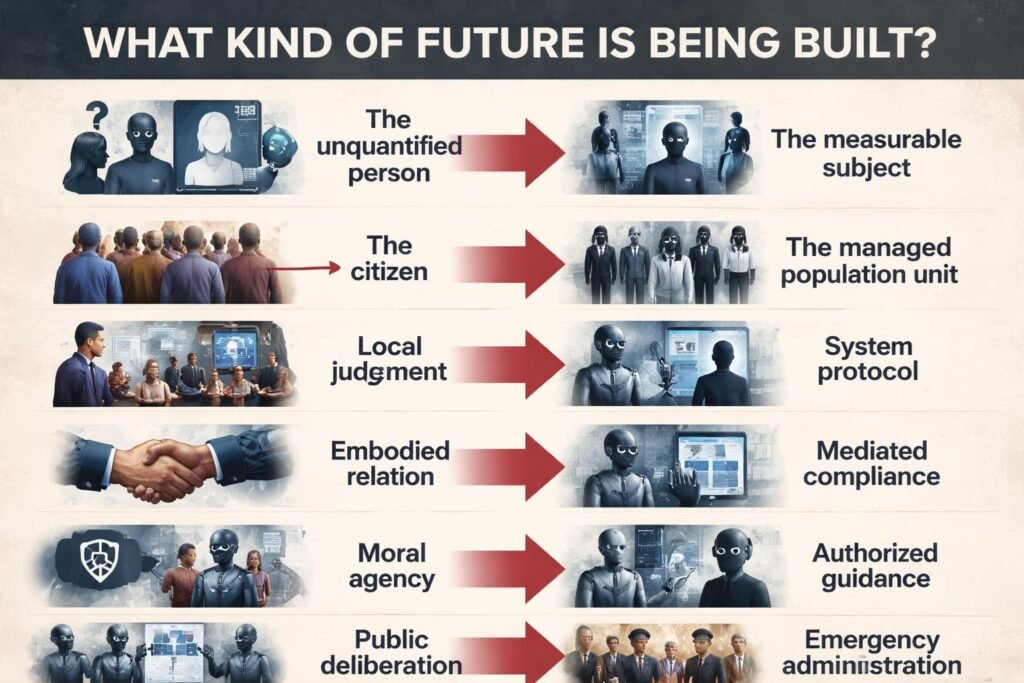
What Kind of Future Is Being Built?
Not necessarily a dramatic dystopia of cloned armies and science fiction theaters. That is the wrong image, and it is also a useful distraction. The more plausible future is quieter and therefore more durable.
It is a world in which biological life is steadily folded into integrated systems of oversight. A world in which the boundaries between medicine, security, administration, commerce, and data are increasingly porous. A world in which emergencies accelerate adoption, ethics trail capability, and institutional coordination deepens with every crisis. A world in which the population is continuously re-described through health, risk, and optimization metrics.
In that world, governance no longer waits for overt coercion. It works through prediction, normalization, incentive design, and moral framing. It does not always need to force. It needs to define the conditions under which compliance feels responsible, dissent feels reckless, and system integration feels inevitable.
That is the real endgame question.
Not: are there secret laboratories doing everything people fear?
But: what political form emerges when biological life itself becomes the preferred terrain of administration?
The hidden hand does not always reach for the throat. Sometimes it reaches for the genome. Sometimes it reaches for the data. Sometimes it reaches for the emergency protocol that nobody reads until it is already in place.
The pattern is consistent. The direction of travel is documented. The question is whether enough people can read it before the architecture becomes too ordinary to question.
Tier 5 Synthesis
Built from the tiers below. This is the author’s synthesis of the documented pattern, not a standalone evidentiary claim.
Taken together, the pattern suggests that cloning, biosecurity, and crisis governance are not isolated developments. They are adjacent expressions of a deeper civilizational shift in how power relates to life. The recurring movement is toward greater legibility, greater intervention capacity, greater integration across institutions, and a more normalized assumption that populations must be managed through biological risk frameworks.
This does not prove a single monolithic plan, and it should not be presented that way. What it does reveal is a directional logic. As scientific capability expands, institutions gain stronger incentives to treat life as something that can be optimized, secured, monitored, and governed at scale. Under crisis conditions, these capacities grow faster. Under moral pressure, they become easier to justify. Under administrative normalization, they become difficult to reverse.
The final structural concern is not simply that biology can be manipulated. It is that biological governance can become the default language through which societies are organized. Once that happens, the population is no longer primarily encountered as a moral community of persons. It is encountered as a field of variables to be managed for stability, resilience, productivity, and control.
If that reading is correct, then the central danger is not one spectacular abuse. It is the gradual construction of a system in which the management of life becomes so ordinary that people forget it was ever possible to think of life differently.
The hidden hand operates in darkness. Every time you bring it into the light, it loses a little of its power. That is enough. That is the work.
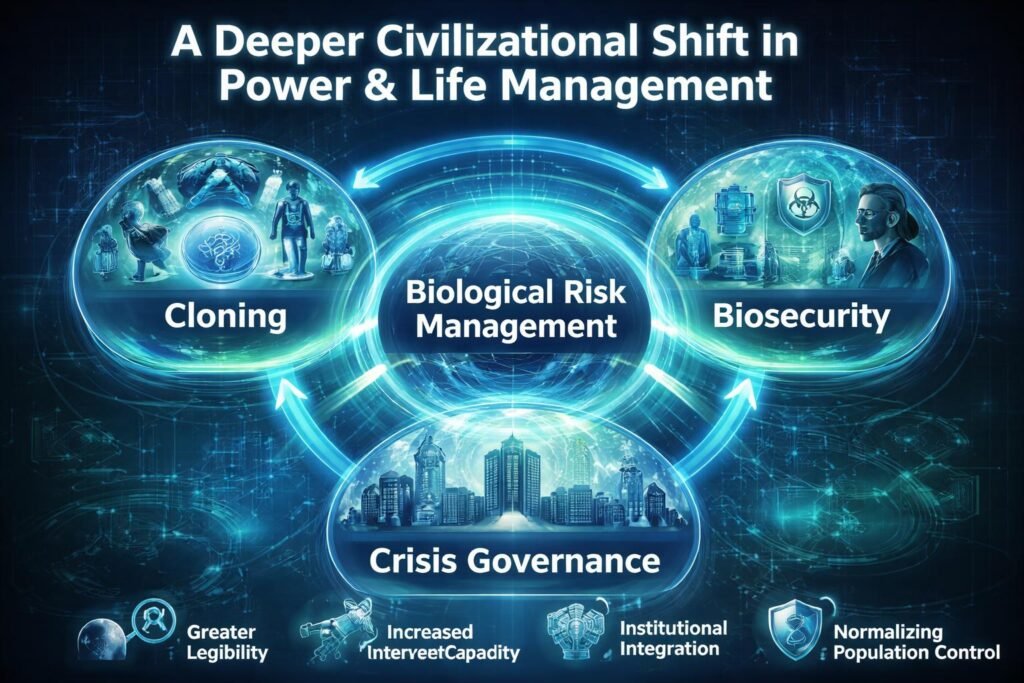
Closing Analysis of the Full Series
Article 1: What Cloning Was Supposed to Do
This article established the official rationale. It showed how cloning entered public legitimacy through the language of healing, regenerative medicine, infertility treatment, and scientific progress. Its purpose in the series was to begin at the strongest level of publicly documented justification rather than at the most controversial inference. The reader is not ambushed. They are walked in through the front door.
Article 2: The Commercial Logic Behind Cloning and Biotech Governance
This article shifted from stated purpose to institutional function. It examined ownership, patent logic, commercialization, regulation, and funding. The argument deepened here: biology was not only being studied or healed, but increasingly organized as an economic domain shaped by incentives, market structure, and legal architecture. The reader begins to see that the science and the money are not separate conversations.
Article 3: Biosecurity and the Administrative Expansion of Biological Control
This article widened the lens from cloning to governance systems. It showed how public health, research oversight, preparedness, and biosurveillance form an expanding field in which biological risk becomes a basis for coordination and control. Here the series moved from biotechnology as an industry to biotechnology as a governing environment. The reader begins to see the walls of the room they are standing in.
Article 4: From Exception to Infrastructure
This article demonstrated the ratchet effect. Crises do not simply produce temporary measures. They often leave behind durable systems, institutional precedents, behavioral norms, and new administrative capacities. Its role in the series was to show how emergency acts as an accelerant for powers already waiting to solidify. The reader begins to understand that the emergency is not the anomaly. The emergency is the method.
Article 5: From Biological Innovation to Population Management
This final article integrated the pattern. It argued that the deeper issue is not any one technology or any one emergency response but the convergence of multiple systems around the governance of life itself. The article does not claim final proof of every darker possibility. Instead, it identifies the documented direction of travel and names the central structural question: when biology, risk, data, and administration converge, what happens to the meaning of the human person within the system? The reader is not told what to conclude. They are given the tools to conclude it themselves.
Related Posts
Continue Reading: The Governance of Life Series
Part 1
What Cloning Was Supposed to Do: The Therapeutic Promise Behind Modern Biotech
The official rationale. The stated science. The institutional justifications. Start here.
Part 2
The Commercial Logic Behind Cloning and Biotech Governance
When biology becomes property. How patent law, funding, and market structure shape what science is allowed to become.
Part 3
Biosecurity and the Administrative Expansion of Biological Control
From public health to population oversight. How risk governance became a governing environment.
Part 4
From Exception to Infrastructure: How Crisis Normalizes Biological Control
The ratchet effect. Why emergency measures rarely disappear and what they leave behind.
You Are Here
From Biological Innovation to Population Management: What Kind of Future Is Being Built?
The full pattern. The convergence. The structural question that the series has been building toward.

Related Reading from The Hidden Hand
How a Public Narrative Is Built Before the Evidence Arrives
The anatomy of managed information. How the story arrives before the facts do.
The Difference Between a Conspiracy Claim and a Structural Analysis
Not all pattern recognition is paranoia. Here is how to tell the difference.
The Structural Literacy Framework
The methodology behind every article on this site. Read systems, not headlines.
If this series raised questions you want to keep pulling on:
About The Hidden Hand — What this site is, what it is not, and why the methodology matters.