
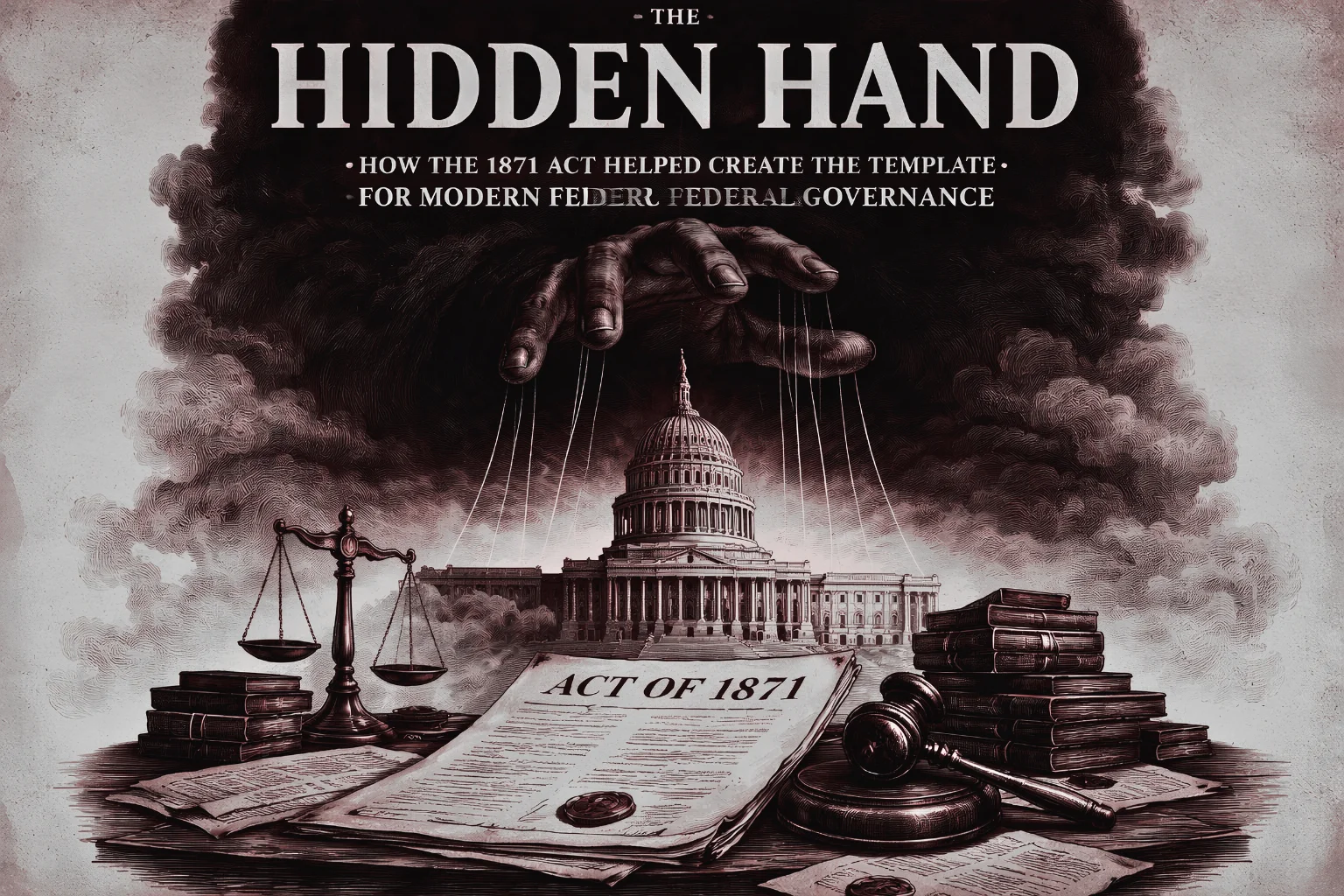
Most people have been taught to think about power in the wrong way.
They imagine it as something theatrical. A conspiracy in a smoke-filled room. A hidden cabal issuing commands. A visible tyrant forcing obedience. Sometimes power does look like that. But often it does not. Often it is quieter, colder, and far more durable.
Often power arrives as structure.
It arrives as a legal template. A delegated authority. A procedural shortcut. A governing body that looks technical, limited, or merely administrative until you realize that the model it introduced never stayed confined to the place where it began.
That is why the District of Columbia Organic Act of 1871 matters.
Not because it secretly replaced the Constitution. Not because it converted the whole nation into a private corporation in one dramatic stroke. And not because it created literal admiralty jurisdiction across the land.
It matters because it introduced, at the federal level, a governing form whose logic would become deeply familiar to modern Americans. A subordinate governing body. Delegated legislative authority. Administrative rulemaking. executive-style enforcement. Corporate capacity. A structure able to act, regulate, contract, spend, and govern without Congress itself directly handling every detail.
That is the deeper story.
And once you see it, the 1871 Act stops looking like a strange local footnote and starts looking like an early prototype.
Before 1871, the Federal Enclave Was a Patchwork
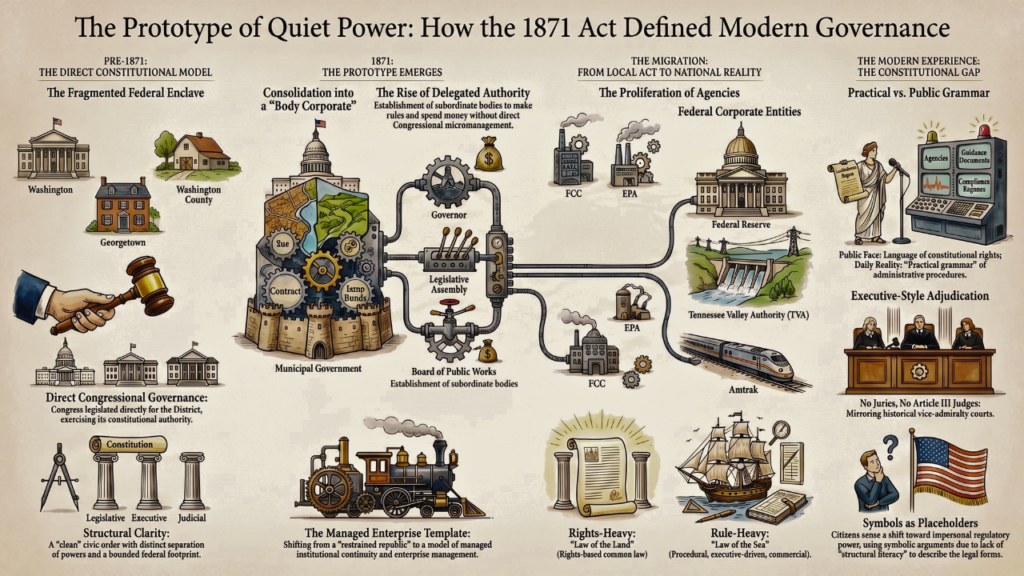
Before the Organic Act, the District of Columbia was not organized as a single unified municipal body. It was a fragmented federal enclave made up of separate jurisdictions, including the City of Washington, Georgetown, and Washington County. Congress governed the District directly under its constitutional authority over the seat of government.
That arrangement was messy, but it had a certain constitutional clarity.
Congress legislated. Local matters remained localized. There was no single consolidated municipal corporation standing in the middle as an all-purpose governing unit. There was no centralized administrative structure that looked anything like a modern agency ecosystem. Governance was direct, bounded, and relatively traditional in form.
Then came 1871.
The Organic Act consolidated the District’s fractured jurisdictions into a single municipal government with corporate powers. It created a governor, a legislative assembly, and a Board of Public Works. This was not just housekeeping. It was a structural shift.
Suddenly, you had something different.
You had a federally created subordinate governing entity with the ability to legislate in a delegated way, administer in an executive way, and function in a corporate way.
That combination matters more than most people realize.
This Is Where Structural Literacy Begins
If you read history only in terms of personalities, you will miss what happened.
If you read it only in terms of slogans, you will miss it too.
But if you read it structurally, a pattern begins to emerge.
The important question is not whether the 1871 Act secretly did everything later critics claim. It did not. The important question is whether it helped normalize a model of governance that would later become central to the federal administrative state.
That answer is much more interesting.
The Act showed that Congress could create a subordinate body and let that body govern in ways that looked partly legislative, partly executive, and partly corporate. It showed that governance could be delegated into a permanent operating structure. It showed that public authority could be exercised through a body that did not fit neatly into the Founders’ simpler separation-of-powers imagination.
In that sense, 1871 was not the end of constitutional government.
It was the beginning of a new habit.
The Pre-1871 Landscape: The Era of “Constitutional Clarity”
Feature
|
Pre-1871 Fragmented Enclave
|
Post-1871 Consolidated Municipal-Corporate Prototype
|
|---|---|---|
Organizational Form
|
Fragmented separate jurisdictions (Washington, Georgetown, etc.)
|
Consolidated municipal-corporate body with delegated rulemaking
|
Legislative Directness
|
Direct congressional legislation; localized matters remained local
|
Delegated legislative authority to a subordinate body
|
Administrative Structure
|
Traditional, bounded, and fragmented
|
Centralized “agency-style” ecosystem
|
Governance Logic
|
Restrained republic; direct oversight
|
Enterprise management; institutional continuity
|
The Rise of Delegated Power
One of the most important features of the 1871 framework was delegated authority.
The district’s assembly could pass laws, subject to congressional override. That may not sound revolutionary at first glance, but structurally it marks a significant move. Congress was no longer handling every local rule itself. It had created a governing body below itself that could produce operative rules within a defined sphere.
That logic should sound familiar.
It is the same basic logic that later underpins much of the administrative state. Congress passes a broad statute. A subordinate body fills in the details. The body writes rules, interprets standards, enforces compliance, and develops an ongoing governing practice that ordinary people experience far more directly than the statute itself.
This is how modern agencies often work.
The Federal Trade Commission, the Federal Communications Commission, the Environmental Protection Agency, and countless other agencies exercise delegated power under broad statutory mandates. The details differ. The legal frameworks differ. But the structural principle is familiar: authority is delegated downward into specialized bodies that govern through ongoing administration.
The 1871 Act did not create the entire modern administrative state by itself. But it did help demonstrate a federal governance model in which delegated authority became operational, durable, and normalized.
That is why it deserves attention.

The Board That Looked a Lot Like the Future
The Board of Public Works created under the Act had authority that should make modern readers pause.
It had spending power. Contracting power. Enforcement power. Rulemaking influence. It was not simply a passive office keeping records. It was an active governing instrument.
And this is where the historical echo becomes difficult to ignore.
Modern agencies do not merely advise. They regulate. They enforce. They issue penalties. They interpret statutes. They administer complex domains of life that Congress itself cannot or will not micromanage. They often combine functions that the Founders preferred to keep distinct.
This is one reason the administrative state feels so alien to people who still imagine government primarily in textbook constitutional terms. On paper, many people still picture a clean civic order in which legislatures make laws, executives enforce them, and courts interpret them. In practice, large portions of modern governance happen inside bodies that do all three in overlapping ways.
That is not exactly what the Constitution’s plain separation of powers seems to promise.
But it is very close to how a municipal-corporate administrative body behaves.
And that is why the 1871 structure matters as precedent.
The Proliferation of the Model
- The Federal Reserve System: Exercises significant administrative autonomy in monetary policy.
- Tennessee Valley Authority (TVA): A federally owned corporation managing regional infrastructure.
- Federal Deposit Insurance Corporation (FDIC): An agency providing insurance while exercising vast regulatory oversight.
- Fannie Mae and Amtrak: Examples of the quasi-public corporate forms performing federal functions.
Corporate Capacity Changed the Shape of Governance
The District, under the new arrangement, could sue and be sued. It could contract. It could issue bonds. It could levy taxes. In other words, it had corporate capacity.
This point is often mishandled by critics. The word “corporation” is heard, and people immediately leap to the conclusion that the nation itself became a privately owned business enterprise. That leap is too crude to survive scrutiny. A municipal corporation is not the same thing as a private shareholder corporation. Public incorporation and private ownership are not interchangeable concepts.
But if we overcorrect and dismiss the issue entirely, we miss something important.
The point is not that incorporation proved a secret coup. The point is that public power was increasingly being organized through forms that resembled enterprise management. Governance became easier to imagine as administration, coordination, contracting, finance, development, and operational control. The logic of the corporation, even in a public form, introduced a style of governing that felt less like the old constitutional ideal of a restrained republic and more like managed institutional continuity.
That style spread.
Over time, Congress increasingly relied on public and quasi-public corporate forms to perform federal functions. The Federal Reserve System, the Tennessee Valley Authority, the FDIC, Fannie Mae, and Amtrak all reflect different versions of that trend. Each occupies its own legal category, but together they reveal a broader pattern. Public purposes are increasingly carried out through structured entities with delegated authority, administrative autonomy, and corporate-style capacities.
That is not a secret. It is a trajectory.
From Constitutional Grammar to Administrative Reality
This is where the discussion gets more serious.
The most important shift in modern governance is not that the Constitution disappeared. It did not.
The deeper shift is that constitutional language often remains the public grammar of legitimacy while administrative structures become the practical grammar of everyday rule.
People still speak of rights, representation, due process, and constitutional order. And those principles still matter. But much of daily governance now happens through agencies, boards, regulations, guidance documents, tribunals, enforcement notices, compliance regimes, and bureaucratic procedures that most people never voted on directly and do not fully understand.
That is the real dilemma.
The old promise remains in the foreground. The newer machinery operates in the background.
The result is a widening gap between constitutional ideals and administrative experience.
The 1871 Act did not create that entire gap. But it helps us see an early federal template for it.

The “Law of the Land” and “Law of the Sea” Metaphor
This is also where people often get carried away.
When critics say the nation moved from the “law of the land” to the “law of the sea,” the strongest version of that claim is metaphorical, not literal. It is not a serious argument that ordinary courts secretly became maritime tribunals because of symbolism, flags, or word games. That is the kind of overstatement that weakens otherwise legitimate concerns.
But the metaphor survives because it captures a real feeling.
The “law of the land” evokes a rights-based constitutional order rooted in common law traditions, fixed protections, jury trials, and a clear separation of powers. The “law of the sea,” as critics use it, evokes something more fluid, more commercial, more executive-driven, more procedural, and more detached from ordinary constitutional instinct.
That metaphor persists because administrative governance often does feel like that.
It feels rule-heavy rather than rights-heavy. It feels executive rather than deliberative. It feels procedural rather than personal. It often routes disputes through internal tribunals, hearing officers, or administrative law judges rather than traditional Article III courts with juries and full constitutional texture.
That does not make it literal admiralty.
But it does explain why the metaphor has emotional force.
Why Administrative Tribunals Feel So Different
The American Founders had strong reasons to distrust executive-style courts. British vice-admiralty courts had become symbols of imperial overreach in the colonial imagination. They operated without juries. They were tied to commercial regulation and revenue collection. They concentrated power in ways the Founders associated with arbitrary government.
That history matters because modern administrative tribunals often produce a similar feeling, even when the legal category is entirely different.
An agency may write rules, investigate alleged violations, enforce penalties, and adjudicate disputes inside its own framework. The judge may not be an Article III judge. There may be no jury. Procedure may be specialized and highly technical. Deference doctrines have historically made courts hesitant to second-guess agencies in many areas. The citizen enters not as a sovereign participant in a grand civic drama, but as a regulated party navigating an institutional process.
That is why so many people feel that something has shifted.
Not because the law secretly became maritime.
But because the administrative state often resurrects the structural feel of executive-centered adjudication that the constitutional imagination was supposed to restrain.
That is a serious observation, and it does not require exaggeration.
For readers who want to study the legal framework itself, the Administrative Procedure Act, Lucia v. SEC, and the history of Chevron deference are important entry points.
The Gold Fringe Problem
One of the reasons this whole subject gets dismissed is because strong structural criticisms are constantly mixed with weak symbolic claims.
A gold-fringed flag in a courtroom is the perfect example.
The U.S. Army Institute of Heraldry is clear that gold fringe is decorative. It does not confer jurisdiction. It does not transform a court into an admiralty court. It is not a hidden legal switch.
And yet people keep coming back to it.
Why?
Because symbols often become placeholders for experiences people do not yet know how to explain. They sense impersonality, executive control, lack of jury participation, summary procedure, and the cold texture of regulatory power. Then they attach those experiences to a visible object and mistake the object for the mechanism.
But the fringe did not create the system.
The system created the experience.
That distinction matters.
The 1871 Act as Prototype, Not Mythic Master Key
This is the most careful and credible way to state the thesis:
The Organic Act of 1871 did not abolish the Constitution, secretly privatize the entire United States, or legally convert all courts into admiralty tribunals.
What it did do was help introduce, at the federal level, a governing model in which delegated authority, corporate capacity, administrative management, and subordinate rulemaking became structurally thinkable and operationally normal.
That is enough.
In fact, that is more than enough.
Because once a legal template exists, it can travel. Once an institutional form proves useful, it can expand. Once a structure becomes familiar, it can be copied into new domains without the public ever noticing the larger pattern.
This is how modern power often grows. Not with a single dramatic overthrow, but through quiet innovations that become permanent habits.
The 1871 Act belongs to that story.
Why This Matters Now
This article is not about antiquarian history. It is about helping the reader recognize the architecture they already live inside.
If you have ever dealt with a federal agency and felt that you were moving through a world of rules you did not write, before officials you did not elect, under procedures you did not design, you have already experienced the legacy of this structural evolution.
If you have ever felt that rights exist most clearly in theory while process dominates in practice, you have already sensed the tension.
If you have ever wondered why so much of modern governance feels less like a republic of first principles and more like a managed enterprise of compliance, forms, notices, and internal adjudication, this history helps explain why.
The 1871 Act is not the whole answer.
But it is one of the early clues.
What the Reader Should Ask
Structural literacy begins when we stop asking only who is behind the curtain and start asking what legal form, what delegation, what procedure, and what institutional design is producing the result.
When an agency acts, ask what statute authorizes it.
When a tribunal rules, ask what kind of court it is and what protections apply.
When a body writes rules, ask whether those rules were directly legislated or administratively generated.
When a process feels detached from constitutional instinct, ask whether you are dealing with an Article III court, an administrative forum, or a hybrid structure whose logic is managerial rather than foundational.
Those questions do more to restore clarity than a thousand symbolic arguments ever will.
Final Reflection
The hidden hand rarely needs to hide in the way people imagine.
It does not always need secret meetings or coded rituals. Often it needs only a legal form that most people will never examine. A delegated authority buried in statute. A board that combines powers once meant to remain separate. A procedural system that feels normal simply because it has been around long enough to become invisible.
That is what makes the 1871 Act important.
It marks an early moment when the federal government adopted a governing template that looks strikingly familiar to the modern administrative mind. A body corporate. A delegated legislature. An executive administrative apparatus. A governing structure able to operate below Congress and yet exercise real public power.
That model did not stay in Washington.
Its logic migrated.
And if we want to understand modern governance honestly, we need to stop looking for mythic master keys and start studying the legal templates that quietly trained the future.
That is where structural literacy begins.