How a Decade of Financial Schemes, Regulatory Violations, and Obstruction Allegations Map Onto RICO’s “Pattern of Racketeering Activity”
by Steafon Perry
Legal Disclaimer: This article presents a structural analysis of publicly documented events, court filings, Federal Election Commission records, and investigative journalism. It does not allege that any individual or organization has committed criminal acts under RICO or any other statute. The framework used here is analytical, not prosecutorial. All claims are sourced and categorized according to a four-tier evidence rubric: [Tier 1] Primary documents and court filings; [Tier 2] Official investigations and regulatory findings; [Tier 3] Reputable investigative journalism with multiple sources; [Tier 4] Contested or interpretive claims consistent with documented patterns but unconfirmed. Readers are encouraged to consult primary sources and draw their own conclusions. Nothing in this article should be construed as legal advice.
“Conspiratorial thinking asks: who is doing this to us? Structural thinking asks: what incentives and institutional arrangements produce this outcome?”
Stefon Perry, Sr., The Hidden Hand: Pattern Language of Modern Power
Introduction: Why RICO, and Why Now?
Let’s start with a question most political commentators refuse to ask: What happens when you stop looking at political scandals as isolated incidents and start examining them the way a federal prosecutor would?
The Racketeer Influenced and Corrupt Organizations Act was not written for the Mafia alone. It was written for any enterprise that engages in a “pattern of racketeering activity,” defined as at least two predicate criminal acts within a ten-year window. The statute targets the organization, not just the individuals. It was designed to dismantle systems, not merely punish bad actors.
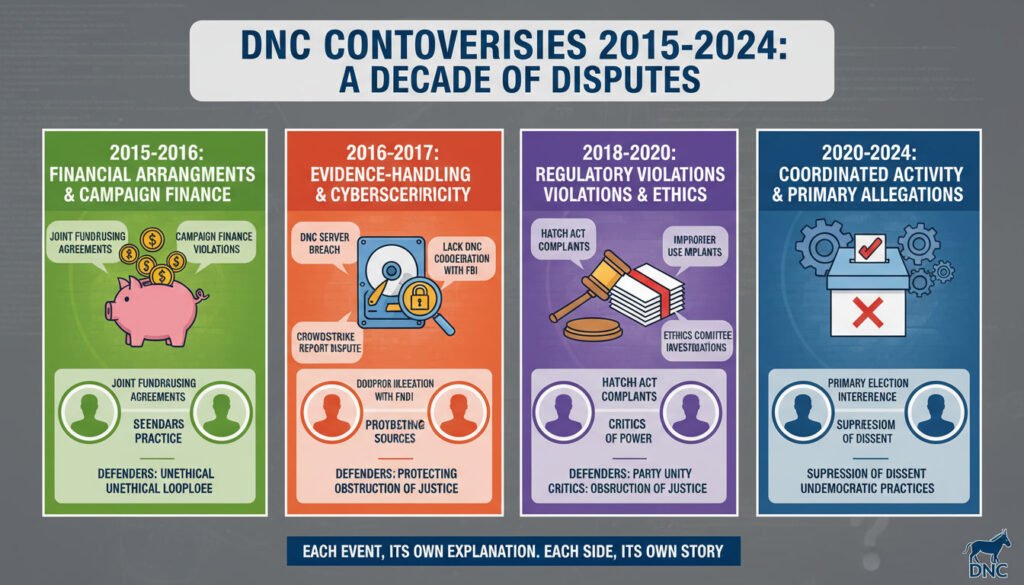
Between 2015 and 2024, the Democratic National Committee found itself at the center of a series of controversies involving financial arrangements, regulatory violations, evidence-handling disputes, and allegations of coordinated activity. Taken one at a time, each event has its own explanation, its own set of defenders and critics. That is how they are typically presented: in isolation, stripped of context, easy to dismiss as partisan noise.
But RICO was never about individual acts. It was about the pattern.
This is not a conspiracy theory. It is a structural analysis, grounded in primary documents, court rulings, FEC enforcement records, and sworn testimony. The goal is not to indict anyone from an armchair. The goal is to ask the question that the structural analyst must always ask: What institutional arrangements and incentive structures produced these outcomes, repeatedly, over a decade?
Let’s walk through the record.
I. The Financial Architecture: Victory Fund, Joint Fundraising, and the $84 Million Question
“Follow the money. Always follow the money.”
Attributed to “Deep Throat” (W. Mark Felt), as dramatized in All the President’s Men
The first thread to pull is the money. Not because money is inherently corrupt, but because campaign finance law exists precisely to prevent the kind of concentrated financial control that distorts democratic competition. When those laws are circumvented through sophisticated financial arrangements, the structural analyst pays attention.
In August 2015, more than five months before the first primary vote was cast, the DNC entered into a Joint Fund-Raising Agreement (JFA) with the Hillary Victory Fund and the Hillary Clinton campaign [20, 24]. This was not, on its face, unusual. Joint fundraising agreements are standard practice in presidential politics. The Sanders campaign was offered a similar arrangement and declined it [21, 27].
What was unusual, according to the person who discovered the agreement’s full terms, was its scope. Donna Brazile, the veteran Democratic strategist who took over as interim DNC chair after Debbie Wasserman Schultz’s resignation in July 2016, described what she found in her 2017 book Hacks and in a widely read Politico excerpt. The DNC, she wrote, was weighed down by debt from the 2012 election cycle. The JFA, she alleged, effectively ceded control of the party’s finances, strategy, and hiring decisions to the Clinton campaign in exchange for operational funding. The DNC, she said, was receiving an “allowance” [20, 26].
Brazile called the arrangement “unethical” and a “cancer” on the party [20, 26, 29]. Context matters here, though. Subsequent reporting indicated that the agreement’s oversight provisions were primarily intended for general election planning, and the Clinton campaign’s control was not absolute in every instance [27]. But Brazile’s characterization, coming from a lifelong Democratic operative who had just served as interim chair, was not a partisan attack from outside. It was a structural critique from within.
The financial questions did not end with the JFA. In December 2017, a conservative group called the Committee to Defend the President filed a complaint with the FEC (MUR 7302) alleging what it described as an “$84 million money laundering scheme” [31, 37]. The theory was straightforward: the Hillary Victory Fund collected large donations and funneled them through dozens of state party committees, which then transferred the funds almost immediately back to the DNC in Washington. The complaint alleged this was designed to circumvent the federal contribution limits that applied to the DNC but not to individual state parties [31, 37].
In 2018, the group sued the FEC, arguing the commission’s failure to act on the complaint was “arbitrary, capricious, and contrary to law” [37]. The FEC did not formally adjudicate the allegation in the same manner as other disclosure complaints. But the factual architecture of the scheme, the movement of money through intermediary entities back to a central recipient, maps directly onto the statutory definition of money laundering: conducting financial transactions designed to disguise the nature, source, or destination of funds.
[Evidence Tier: The JFA itself is Tier 1 (primary document). Brazile’s account is Tier 3 (investigative journalism by a direct participant). The $84 million complaint is Tier 1 (FEC filing). The allegation remains Tier 4 (contested, not formally adjudicated by the FEC).]
Whether or not any prosecutor would ever bring this case, the structural question remains: What institutional arrangements allowed a presidential campaign to effectively control a national party apparatus more than a year before the nominating convention, while donors believed they were contributing to “the party”?
II. The Disclosure Deception: Hiding the Dossier and the FEC’s “Probable Cause” Finding
If the Victory Fund controversy raised questions about how money moved, the Steele dossier controversy raised questions about how that movement was concealed.
In April 2016, the Hillary for America campaign and the DNC, through their shared law firm Perkins Coie, retained the strategic intelligence firm Fusion GPS. Fusion GPS then hired former British intelligence officer Christopher Steele to conduct opposition research on Donald Trump [74, 77, 78, 83]. The payments from the campaign and the DNC to Perkins Coie were disclosed on FEC filings under the purpose of “Legal Services” or “Legal and Compliance Consulting” [36, 82, 85].
In October 2017, the Campaign Legal Center, a nonpartisan watchdog group, filed a complaint with the FEC alleging that this reporting was deliberately misleading [36, 85]. Their argument was that Perkins Coie was functioning as a passthrough, and the true purpose of the spending, opposition research, was being obscured behind a generic label. The complaint characterized this as a violation of the Federal Election Campaign Act’s transparency requirements [36, 38].
The FEC investigation that followed, documented as Matters Under Review 7291 and 7449, took years to resolve. But its conclusion was unambiguous. On December 15, 2021, the Commission’s Office of General Counsel issued a report finding “probable cause to believe” that both the DNC and the Clinton campaign had violated federal law by misreporting the purpose of the disbursements [87, 88, 172, 174]. The DNC and the campaign argued that because the research was conducted at the direction of legal counsel, the “legal services” label was appropriate [174, 180]. The FEC rejected this defense, concluding that the descriptions were insufficiently specific to make the nature of the expenditure clear to the public [172].
In February 2022, the DNC and the Clinton campaign entered into conciliation agreements. Without admitting wrongdoing, they agreed to pay civil penalties: $105,000 for the DNC and $8,000 for the Clinton campaign [81, 82, 86, 88]. Complaints against Perkins Coie, Fusion GPS, and Steele himself were dismissed [83, 87].
[Evidence Tier: This is overwhelmingly Tier 1 and Tier 2. The FEC complaint, the General Counsel’s report, the conciliation agreements, and the penalties are all primary federal regulatory documents available on fec.gov.]
Now, a regulatory fine is not a criminal conviction. And a conciliation agreement is not an admission of guilt. These distinctions matter. But within a structural analysis, the finding is significant for what it documents: a deliberate scheme to route payments through an intermediary law firm and to label them in a way that obscured their true purpose from voters, journalists, and regulators. The FEC’s own lawyers called it a violation. The DNC paid six figures to make the inquiry go away.
If this were the only financial irregularity on the record, it might be chalked up to aggressive but common campaign lawyering. But it was not the only one. And under RICO analysis, the question is never about the isolated act. It is about the pattern.
III. The Neutrality Fraud: What the Courts Actually Said About “Back Rooms”
While the financial controversies played out in regulatory filings, a parallel drama was unfolding in federal court.
On July 22, 2016, WikiLeaks published nearly 20,000 internal DNC emails spanning from January 2015 to May 2016 [7, 11]. The timing, days before the Democratic National Convention in Philadelphia, was devastating. The leaked correspondence showed that senior DNC officials, despite the party charter’s explicit requirement that the chair and staff maintain “impartiality and even-handedness,” harbored a clear institutional preference for Hillary Clinton over Bernie Sanders [7, 10, 13].
The emails contained more than idle chatter. One exchange involved the DNC’s chief financial officer, Brad Marshall, who floated the idea of questioning Sanders’s religious beliefs to damage his standing with voters in Southern states [7, 13, 16]. Other emails showed DNC staff disparaging Sanders and his campaign manager [7, 10]. While no single document constituted a “smoking gun” proving the primary was rigged in a mechanical sense, the emails revealed a pervasive institutional bias that contradicted the party’s public posture of neutrality [13].
The political consequences were swift. Debbie Wasserman Schultz resigned as DNC chair under intense pressure [1, 2, 9]. The DNC’s incoming leadership, under interim chair Donna Brazile, issued a formal apology to Sanders, his supporters, and “the entire Democratic Party” for what it called “inexcusable remarks made over email” [59].
But it was the legal fallout that proved most revealing. Sanders supporters filed a class-action lawsuit, Wilding v. DNC Services Corp., alleging fraud and breach of fiduciary duty. The plaintiffs argued that the DNC’s charter created a binding contractual obligation to maintain impartiality, an obligation the leaked emails showed the party had violated [40, 42, 43].
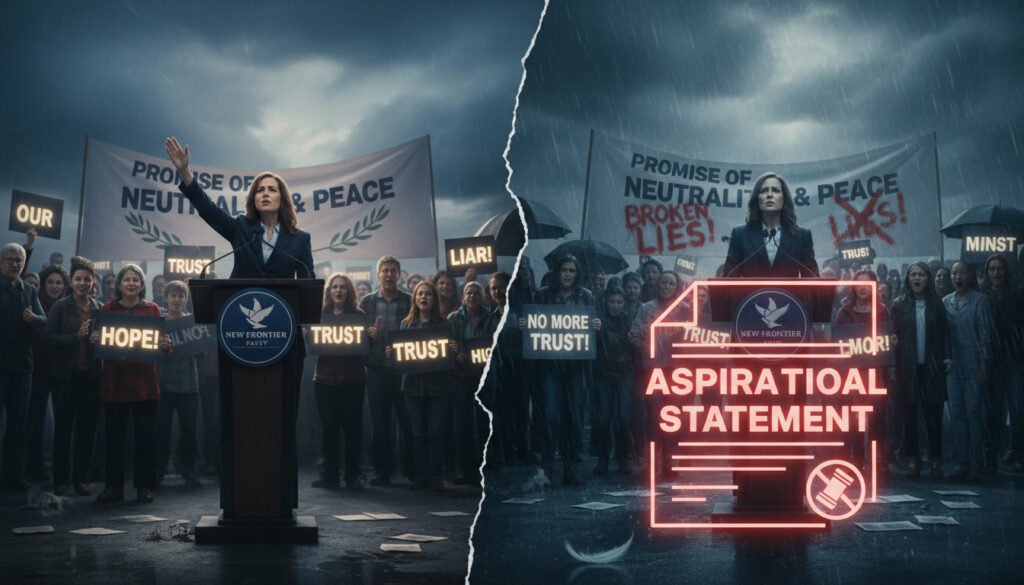
The DNC’s legal defense was remarkable in its candor. Its attorneys argued in court that the party’s internal rules were discretionary and that the DNC retained the right to select its nominee in “back rooms” if it so chose [41, 47, 48]. This was not a leaked comment or an off-the-record remark. This was a formal legal argument made in a federal courtroom, preserved in court records.
The courts sided with the DNC. In August 2017, the district court dismissed the case. In 2019, the 11th U.S. Circuit Court of Appeals affirmed, ruling that the DNC Charter’s neutrality clause represented “aspirational political promises” rather than a legally enforceable contract [45, 49, 63, 66]. The court cited the First Amendment’s protection of associational rights, concluding that political parties have broad autonomy over their internal affairs [49, 63]. The Supreme Court declined to hear the case in 2020 [44, 66].
[Evidence Tier: All Tier 1. The court filings, the DNC’s legal arguments, and the appellate ruling are federal court records.
The structural analyst does not read this case as a vindication of the DNC. The courts did not rule that the DNC acted fairly. They ruled that fairness, as promised in the party’s own charter, was not a judicially enforceable obligation. They ruled, in effect, that a political party can promise neutrality to its donors and supporters, break that promise, and face no legal consequence because the promise was merely “aspirational.”
For donors who contributed to the DNC believing their money would support a fair process, the distinction between a legal right and a broken promise may feel academic. Under fraud analysis, the question is whether funds were solicited under false pretenses. The courts said that is a political question, not a legal one. Reasonable people can decide for themselves what they think about that.
IV. Obstruction and Evidence Handling: Hammers, Servers, and Tarmac Meetings
The 2016 controversies did not occur in a vacuum. They unfolded alongside a separate but overlapping investigation into Hillary Clinton’s use of a private email server during her tenure as Secretary of State, an investigation that generated its own set of obstruction allegations.
CNN confirmed that Clinton aides destroyed mobile devices with hammers during the investigation [Source: CNN fact-check, as cited in Free Beacon]. Separately, the DNC’s handling of its hacked servers drew sustained criticism. After retaining the private cybersecurity firm CrowdStrike to investigate the breach, the DNC provided the FBI with forensic images (exact copies) of its servers rather than the physical hardware [60, 102, 106]. Critics, including then-candidate Donald Trump, characterized this as obstruction of the FBI’s investigation [60].
Officials from both the FBI and CrowdStrike stated that this practice, relying on forensic images rather than physical servers, was standard and acceptable [60, 106]. Former FBI Director James Comey testified that relying on forensic data from a trusted private firm was appropriate [106].
But CrowdStrike co-founder Shawn Henry later acknowledged in declassified testimony that his firm lacked “concrete evidence” of data exfiltration, relying instead on “circumstantial evidence” to determine with “high confidence” that Russian state actors were responsible [103]. The Department of Justice later affirmed it had independently verified CrowdStrike’s findings [106, 148].
Then there was the matter of Debbie Wasserman Schultz and Imran Awan. According to video evidence, Wasserman Schultz was recorded confronting U.S. Capitol Police Chief Matthew Verderosa, pressuring him regarding the gathering of evidence related to Awan’s apparent criminal activity [Source: Medium/Tim Canova]. The confrontation raised questions about whether a sitting member of Congress attempted to interfere with an active law enforcement investigation.
[Evidence Tier: CNN’s confirmation of device destruction is Tier 3 (major network fact-check). CrowdStrike’s testimony and DOJ verification are Tier 1 and Tier 2, respectively. The Wasserman Schultz/Awan video is Tier 3 (documented but context-disputed).
Under RICO analysis, obstruction of justice and obstruction of criminal investigations are both enumerated predicate offenses. The structural question is not whether any single act of obstruction occurred in isolation. It is whether a pattern of conduct, across multiple incidents involving related actors within the same organizational ecosystem, rises to the level of coordinated enterprise activity.

V. The Conviction That Actually Happened: Roger Stone and the DNC Leak Investigation
While many of the allegations discussed above remain in the realm of regulatory findings and dismissed lawsuits, one criminal prosecution arising from the DNC leak investigation did produce a conviction on charges that are explicit RICO predicate offenses.
In January 2019, Roger Stone, a longtime associate of Donald Trump, was indicted on charges of obstruction of an official proceeding, making false statements to Congress, and witness tampering [127]. The charges stemmed from his efforts to conceal communications with WikiLeaks and the persona “Guccifer 2.0,” which was later identified as a front for Russian GRU officers, regarding the release of stolen DNC emails [108, 110, 127].
Court filings revealed that the Special Counsel’s office had obtained electronic records of Stone’s direct communications with both entities [108, 110, 112]. He was found guilty on all seven counts, including tampering with the testimony of witness Randy Credico [127].
[Evidence Tier: Tier 1. The indictment, trial record, and conviction are federal court records available through the Department of Justice.]
The Stone conviction is significant within a structural analysis for a specific reason: it demonstrates that criminal acts, including acts that are explicit RICO predicates (obstruction and witness tampering), were committed within the broader ecosystem of the DNC email leak controversy. While Stone’s conviction implicates Trump associates rather than the DNC itself, it establishes that the events surrounding the DNC’s 2016 crisis produced adjudicated criminal conduct. A thorough structural analysis examines the entire ecosystem, not just one side of it.
VI. The DNC’s Own RICO Playbook: Suing Russia, Trump, and WikiLeaks
Here is where the analysis takes an ironic turn.
In April 2018, the DNC filed its own civil lawsuit in the Southern District of New York against the Russian Federation, the GRU, the Trump campaign, WikiLeaks, Julian Assange, and several Trump associates [119, 122, 163, 165]. The DNC’s complaint alleged a wide-ranging racketeering conspiracy to interfere in the 2016 election. The DNC, in other words, chose the RICO framework itself to describe the actions of its opponents.
In July 2019, U.S. District Judge John G. Koeltl dismissed the lawsuit with prejudice [120, 122, 123]. Russia was shielded by the Foreign Sovereign Immunities Act [119, 121]. The remaining defendants, including the Trump campaign and WikiLeaks, were protected by the First Amendment. Judge Koeltl drew a parallel to the Pentagon Papers case, noting that publishing information of public concern is constitutionally protected, even if the source obtained the material illegally, so long as the publisher did not participate in the initial theft [120, 121]. The court found the DNC had failed to plausibly allege that any defendant besides Russia participated in the hack itself [122].
[Evidence Tier: Tier 1. Federal court filing and dismissal order.]
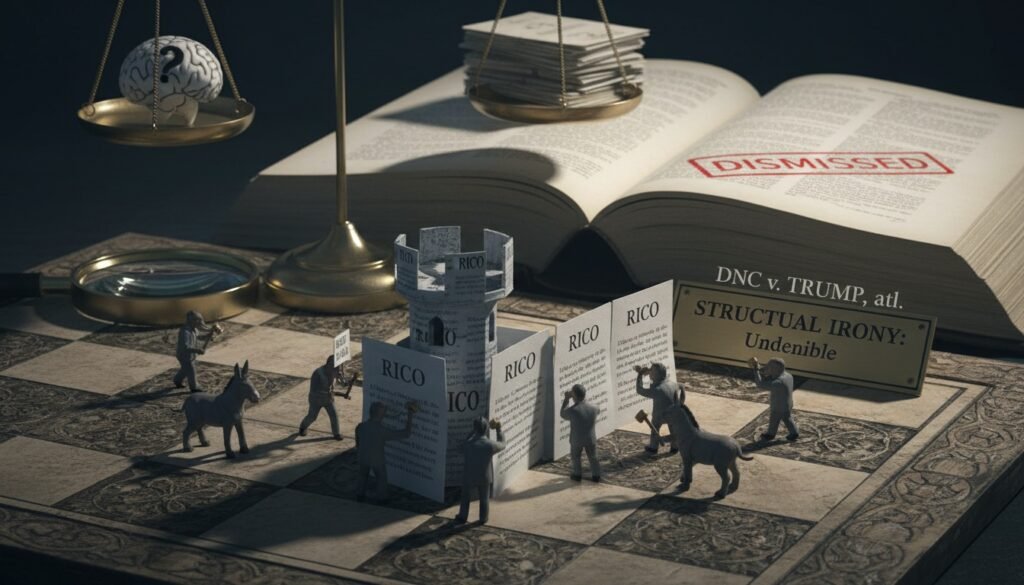
The structural irony is hard to miss. The DNC deployed RICO’s legal framework against its political adversaries, asserting that a pattern of coordinated activity constituted racketeering. The court disagreed on the law but did not dispute the analytical framework. The question this article poses is simply this: What happens when that same framework is applied, with the same rigor and the same evidentiary standards, to the DNC’s own documented conduct?
VII. 2024 and Beyond: The Pattern Continues
The pattern did not end in 2016 or even 2022. In February 2024, the DNC filed a formal FEC complaint against independent presidential candidate Robert F. Kennedy Jr.’s campaign and the allied Super PAC American Values 2024, alleging an illegal ballot-access coordination scheme [160, 161, 162]. The DNC argued that the Super PAC’s plan to spend $15 million on ballot access signature-gathering constituted an illegal in-kind contribution because many states require direct candidate involvement in the petitioning process [160, 163, 165, 166].
The Kennedy campaign denied the allegations, calling the complaint “desperate” [162, 163, 166]. The DNC subsequently filed additional complaints against the PAC related to its financial disclosure practices [168, 169].
In a separate action reflecting ongoing tensions over election law enforcement, the DNC is currently a plaintiff in a 2025 lawsuit, DNC v. Trump, et al., challenging an executive order that the DNC argues unlawfully transfers authority for interpreting campaign finance law from the FEC to the executive branch [39, 165].
[Evidence Tier: Tier 1. FEC complaints and federal court filings.]
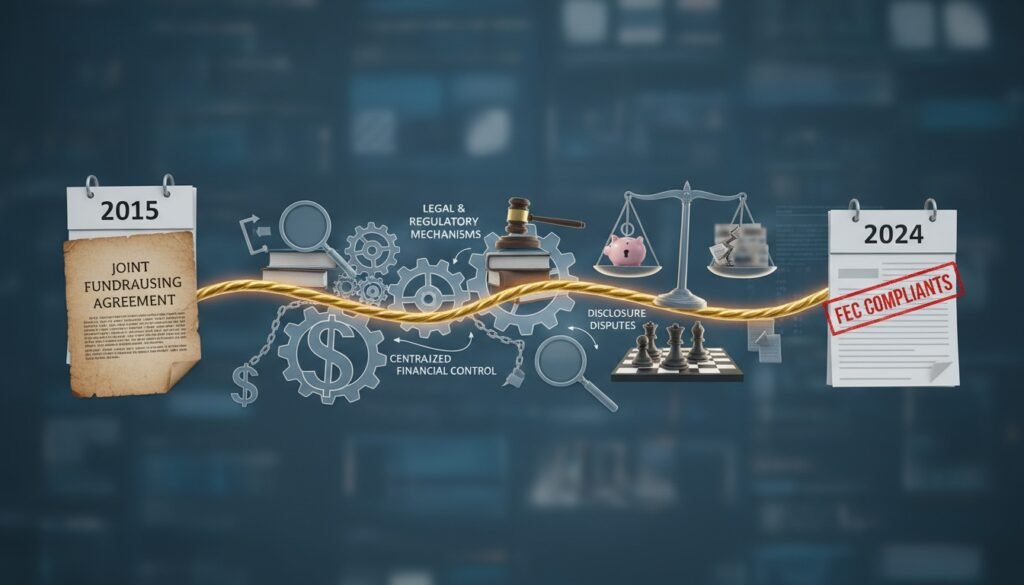
The structural analyst notes the continuity. From 2015’s joint fundraising agreement to 2024’s FEC complaints, the pattern involves the same institutional actor, the same legal and regulatory mechanisms, and the same recurring themes: centralized financial control, disputes over disclosure practices, and the use of legal and regulatory processes as instruments of political competition.
VIII. Structural Conclusions: Incentives, Not Villains
Let us return to the foundational question of structural analysis: What institutional arrangements and incentive structures produce these outcomes?
The answer is not that the DNC is uniquely corrupt. Political institutions across the spectrum face similar structural pressures. The Republican National Committee has its own history of regulatory violations, financial controversies, and legal battles. This is not a partisan indictment. It is an examination of what happens when any organization operates within a system where the incentives for winning elections overwhelm the incentives for democratic accountability.
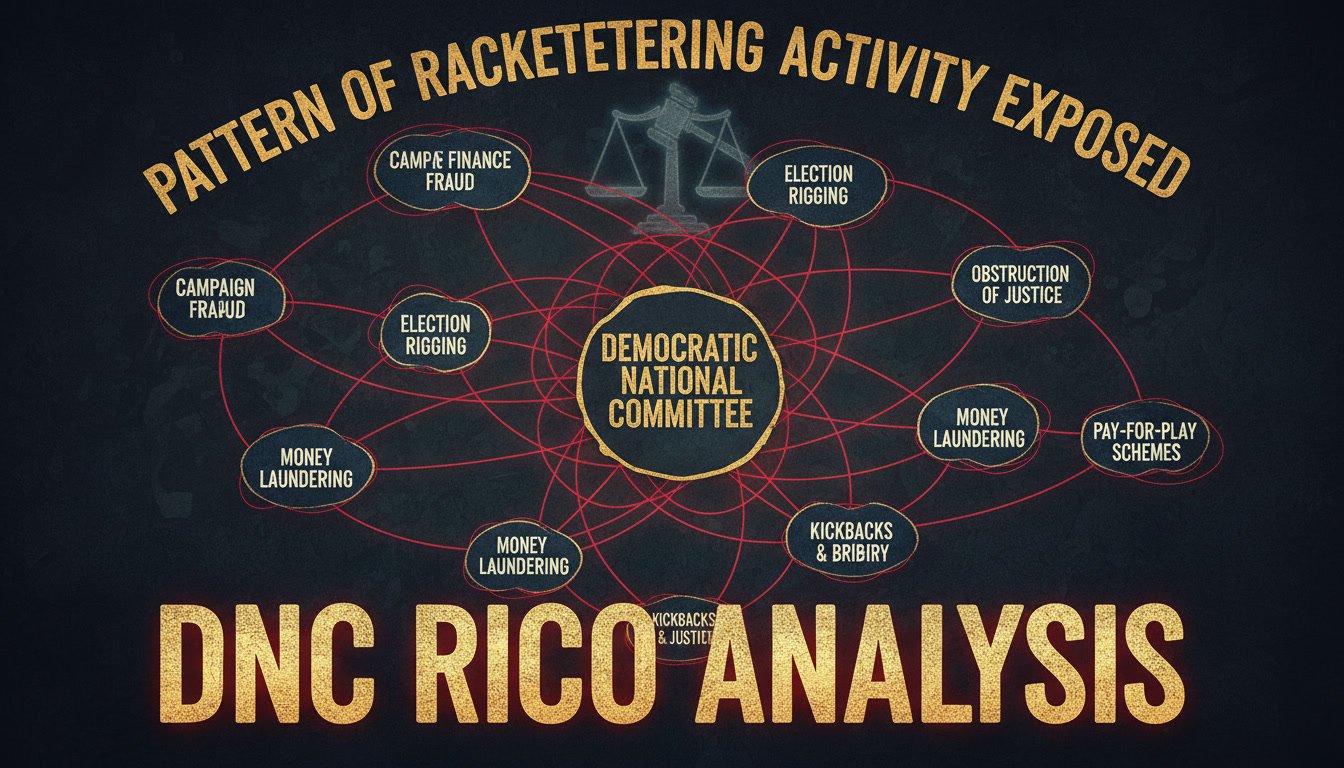
The pattern that emerges from the documentary record between 2015 and 2024 includes:
- A joint fundraising arrangement that centralized financial control within a presidential campaign before the primary process had even begun [20, 24]
- Allegations of an $84 million scheme to circumvent federal contribution limits using state party committees as intermediaries [31, 37]
- An FEC finding of “probable cause” that the DNC and the Clinton campaign violated federal law by misreporting opposition research expenditures, resulting in a six-figure penalty [81, 87, 88]
- Leaked emails revealing institutional bias in violation of the party’s own charter neutrality requirements [7, 13]
- A legal defense in which the DNC argued it had no obligation to honor its own neutrality promises, and that nominating processes could be conducted in “back rooms” [41, 47, 48]
- Documented instances of device destruction and confrontation with law enforcement during related investigations [Source: CNN; Medium/Tim Canova]
- A criminal conviction for obstruction and witness tampering arising directly from the investigation of DNC email leaks [127]
- Continued use of FEC complaints and federal litigation as instruments of political competition against third-party challengers [160, 161]
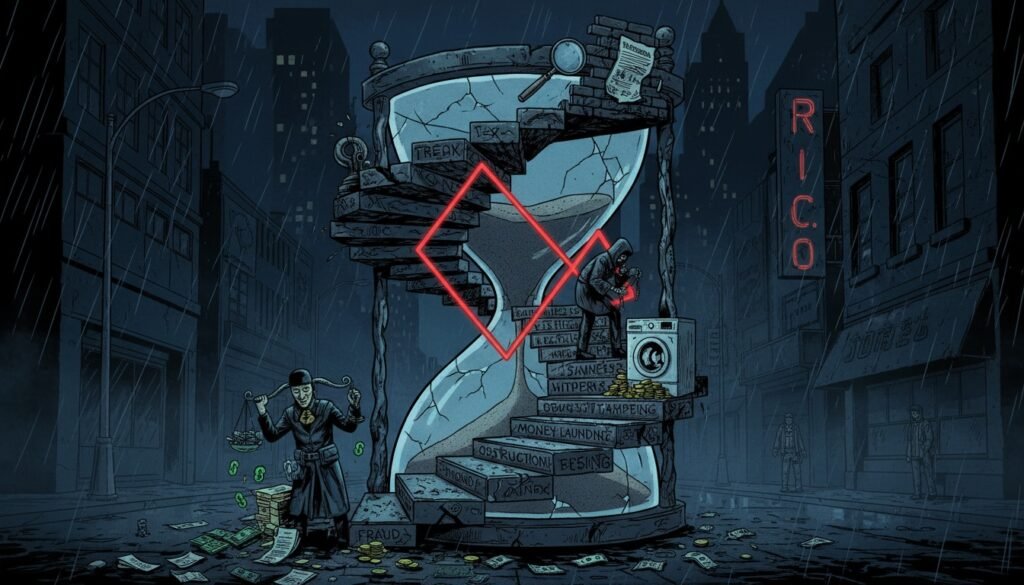
Under RICO analysis, the statute requires a “pattern of racketeering activity” consisting of at least two predicate acts within a ten-year period. The predicate offenses enumerated in the statute include fraud, money laundering, obstruction of justice, witness tampering, and obstruction of criminal investigations. The documentary record presented here, grounded primarily in Tier 1 and Tier 2 sources, identifies multiple events that map onto these predicate categories across a nine-year span.
This does not mean a RICO prosecution is warranted, likely, or even possible. Legal standards for criminal prosecution are far higher than the standards for journalistic analysis. What it means is that the pattern exists in the public record, documented by federal courts, federal regulatory agencies, and the DNC’s own statements and legal filings.
The
, as Perry writes in The Hidden Hand: Pattern Language of Modern Power, “can only work in darkness. Bring it into the light, and it loses its power.”
The structural mechanisms documented here are not secret. They are hiding in plain sight, scattered across court filings, FEC databases, and news archives. The purpose of this analysis has been to assemble them in one place and to examine them through the structural lens that the law itself provides.
The pattern is the point. What you do with it is up to you.
This article reflects the analytical framework of The Hidden Hand: Pattern Language of Modern Power by Stefon Perry, Sr. For more on the structural mechanisms that shape democratic institutions, visit thehiddenhand.net.
References
- “Democratic National Committee chief stepping aside after convention.” NBC News, July 24, 2016.
- “Debbie Wasserman Schultz resigns as DNC chair after email leak.” The Guardian, July 24, 2016.
- “2016 Democratic National Committee email leak.” Wikipedia.
- “Debbie Wasserman Schultz to Resign as DNC Chair.” TIME, July 24, 2016.
- “DNC chair Debbie Wasserman Schultz to resign after convention.” USA TODAY, July 24, 2016.
- “Hacked DNC Emails.” WikiLeaks, July 22, 2016.
- “The DNC email leak, explained.” Vox, July 23, 2016.
- “Most Damaging Emails From DNC WikiLeaks Dump.” ABC News.
- “Inside Hillary Clinton’s Secret Takeover of the DNC.” Donna Brazile, POLITICO Magazine, November 2, 2017.
- “The Donna Brazile-DNC-Hillary Clinton controversy, explained.” Vox, November 2, 2017.
- “Book Reveals Clinton Campaign Effectively Controlled DNC As Early As 2015.” NPR, November 3, 2017.
- “Donna Brazile Says DNC Deal With Clinton Was ‘Unethical.'” TIME, November 2, 2017.
- “Brazile’s Revelations About the Clinton Campaign Are Not as Explosive as They Seem.” The Nation.
- “Hillary Clinton’s DNC deal ‘unethical’ says party chief.” BBC News.
- “Supplemental Complaint and Exhibits.” FEC MUR 7302. Federal Election Commission.
- “FEC Complaint: Hillary for America & DNC Failure to Disclose.” Campaign Legal Center.
- “FEC hit with lawsuit over ‘ignoring’ civil complaint accusing Clinton, DNC in election scheme.” Fox News.
- “Clinton, DNC Falsified Finance Records to Hide Dossier Ties, Complaint Says.” Courthouse News Service.
- “DNC, et al. v. Trump for President, Inc., et al.” FEC memorandum, March 21, 2025.
- “Bernie Sanders Backers Battle DNC in 11th Circuit.” Courthouse News Service.
- “DNC Lawsuit Reveals DNC Leadership Could Have Rigged Primaries.” Observer, May 2017.
- “Wilding v. DNC Services Corp.” Grokipedia.
- “Leaked DNC E-mails Suggest Anti-Sanders Bias.” IVN.us, July 25, 2016.
- “Wilding Petition.” Supreme Court of the United States, Docket 19-1185.
- “Wasserman Schultz, DNC ‘Rigged’ Primary? Judge Dismisses Fraud Lawsuit.” Sunshine State News.
- “DNC Lawyers Argue Primary Rigging Lawsuit Should Be Dismissed.” Newsweek.
- “Reminder: DNC Lawyers to Court: We Do Not Owe Voters an ‘Impartial or Evenhanded’ Primary Election.” Naked Capitalism.
- “11th Circuit tosses suit claiming DNC unfairly favored Hillary Clinton over Bernie Sanders.” ABA Journal.
- “DNC Statement on Released Emails.” Democrats.org, July 25, 2016.
- “PolitiFact: Donald Trump’s ‘missing server’ comments.” Democrats.org.
- “Wilding v. DNC Services Corp.” FindLaw.
- “Wilding v. DNC Services Corp.” Wikipedia.
- “Steele dossier.” Wikipedia.
- “Obama’s Campaign Gave $972,000 To Law Firm That Funneled Money To Fusion GPS.” The Federalist, October 29, 2017.
- “Perkins Coie paid firm that compiled Trump dossier on behalf of Clinton campaign and DNC.” ABA Journal.
- “Clinton campaign, DNC fined for funding of ‘Steele dossier.'” AP News, March 30, 2022.
- “DNC, Clinton campaign fined over Trump-Russia dossier disclosures.” POLITICO, March 30, 2022.
- “Fusion GPS.” Wikipedia.
- “CLC: Hillary for America & DNC Failed to Disclose Legally Required Information.” Campaign Legal Center.
- “FEC fines Clinton campaign and DNC for dossier spending.” The Washington Post, March 30, 2022.
- “MUR #7291.” Federal Election Commission.
- “MUR #7449.” Federal Election Commission.
- “Fox News Settles With Seth Rich’s Parents Over False Story.” NPR, November 24, 2020.
- “Democratic National Committee cyber attacks.” Wikipedia.
- “Dem Cyber-Firm’s Sworn Testimony It Had No Proof of Russian Hack of DNC.” RealClearInvestigations, May 13, 2020.
- “DOJ’s Inspector General Report: Myths and Facts on Russia Inquiry Origins.” American Constitution Society.
- “Prosecutors Say Stone Communicated With WikiLeaks, and They Have the Receipts.” VICE.
- “Prosecutors say they have evidence of Stone’s communications with WikiLeaks.” CNN.
- “New filing suggests Mueller has evidence Stone communicated with WikiLeaks, Guccifer 2.0.” The Hill.
- “Democratic National Committee v. Russian Federation.” Wikipedia.
- “DNC v. Russian Federation.” Knight First Amendment Institute.
- “Federal judge dismisses DNC suit against Russia, Trump campaign.” ABC News.
- “Judge dismisses DNC lawsuit over 2016 hacks.” POLITICO.
- “DNC lawsuit against Trump campaign, Russia and WikiLeaks over hacking is dismissed.” Fox News.
- “Roger Stone Found Guilty of Obstruction, False Statements, and Witness Tampering.” U.S. Department of Justice.
- “Report of Investigation of Unauthorized Disclosures of Sensitive Information.” DOJ Office of Inspector General.
- “Fox News Insisted Seth Rich Settlement Stay Secret Until After Election.” TheWrap; also: “DNC Files FEC Complaint Against Super PAC American Values 2024 and Robert F. Kennedy, Jr.’s Campaign.” Democrats.org.
- “DNC Files FEC Complaint Against Super PAC American Values 2024.” Democrats.org, February 9, 2024.
- “DNC alleges RFK Jr. campaign violating election law in FEC complaint.” Fox News.
- “DNC files FEC complaint against RFK Jr’s campaign and super PAC.” CNN.
- “DNC v. Trump Preliminary Injunction Memo.” FEC, March 11, 2025.
- “Kennedy campaign faces collusion allegations over super PAC’s ballot access effort.” CBS News.
- “DNC expands on its legal complaints against RFK Jr’s campaign and super PAC.” CNN.
- “DNC alleges ‘shady’ fundraising in latest complaint against RFK Jr. super PAC.” CBS News.
- “First General Counsel’s Report, MUR 7291.” Federal Election Commission.
- “General Counsel’s Report, MUR 7449.” Federal Election Commission.
- “Response of Hillary for America and Elizabeth Jones, MUR 7449.” Federal Election Commission.