
——————————————————————————–
1. Foundational Framework: Structural Analysis vs. Narrative Framing
This report employs a Structural Analysis methodology, a technical framework that prioritizes institutional incentives, documented paper trails, and systemic design over narrative-driven theories.
While traditional narratives focus on individual actors or cabals, structural analysis examines the “load-bearing” elements of power: how regulatory revolving doors, monetary architecture, and information filters produce predictable outcomes regardless of the individuals operating the machinery. This approach treats power dynamics as a matter of institutional physics rather than personal conspiracy.
Standards of Evidence Rubric
To maintain technical rigor, all evidentiary claims are categorized according to the following Tier system:
- [TIER 1] Primary Documents: Declassified government records (e.g., Operation Northwoods, NSA Gulf of Tonkin documents), court filings, and official commission reports.
- [TIER 2] Official Investigation or Peer-Reviewed Research: Findings from bipartisan inquiries (e.g., Financial Crisis Inquiry Commission) or landmark academic studies (e.g., Friedman and Schwartz).
- [TIER 3] Reputable Investigative Journalism: Reporting confirmed by multiple sources or subsequent official acknowledgment (e.g., the Twitter Files).
- [TIER 4] Contested or Interpretive Claims: Plausible pattern analysis consistent with documented evidence but lacking primary confirmation.
The Eight Elements of the Playbook
The maintenance of structural power consistently relies on a repertoire of eight techniques:
- Media Management: Cultivating institutional capture of the press.
- Language Manipulation: Using linguistics to bypass rational analysis.
- Crisis Creation: Exploiting emergencies to bypass democratic constraints.
- Opposition Management: Neutralizing dissent through infiltration or monetization.
- Military Expansion: Maintaining permanent conflict to sustain industrial budgets.
- Elimination: Removing threats via character assassination, lawfare, or physical means.
- Surveillance: Establishing behavioral data extraction as a means of social control.
- Financial Architecture: Utilizing debt and monetary issuance as a lever of sovereignty.

2. The Financial Architecture: From Jekyll Island to CBDCs
The 1913 Foundation
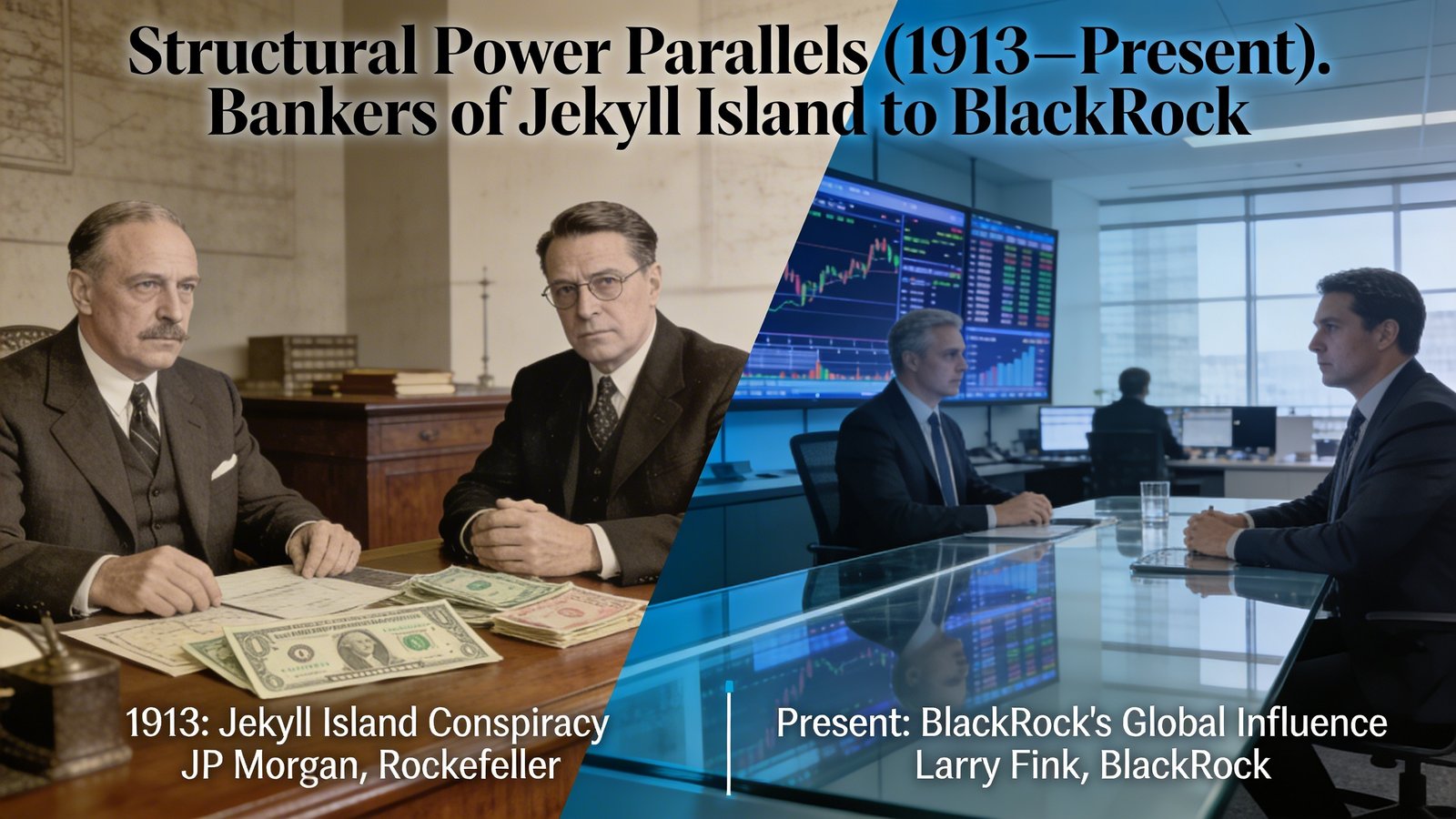
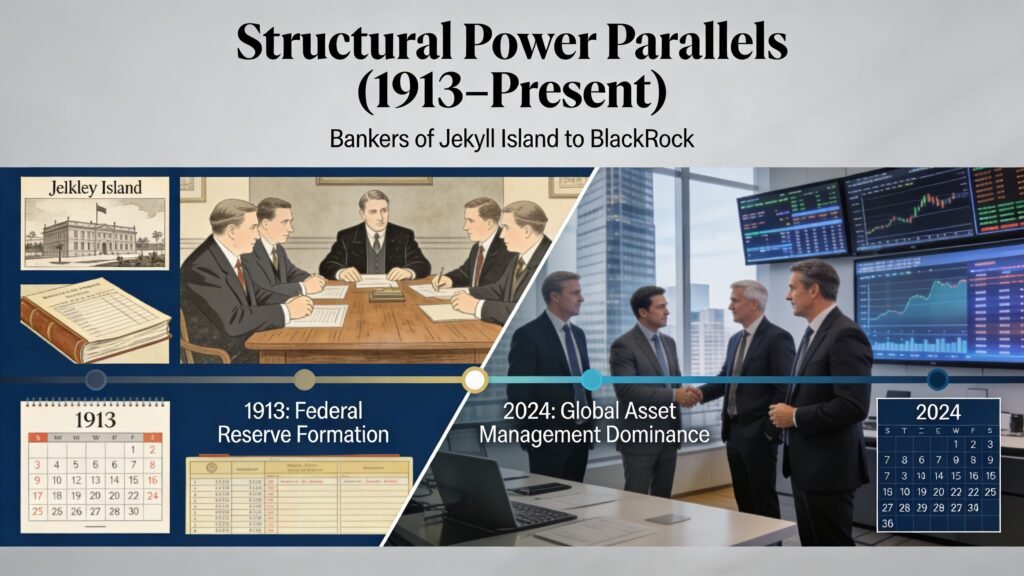
The modern U.S. monetary system was architected during a secretive nine-day meeting in November 1910 at Jekyll Island, Georgia. The participants included Senator Nelson Aldrich, Paul Warburg (Kuhn, Loeb and Co.), Henry Davison (J.P. Morgan), Benjamin Strong (Bankers Trust), and Frank Vanderlip (National City Bank).
Representing one-quarter of global wealth, these men drafted the Federal Reserve Act in what Vanderlip later described in a 1935 Saturday Evening Post account as a “furtive” process.
He admitted, “If it were to be exposed publicly that our particular group had gotten together and written a banking bill, that bill would have no chance whatsoever of passage by Congress.”
The resulting institution gained the power to set interest rates and manage money supply with deliberate independence from democratic oversight. Regarding the Fed’s role in the Great Depression, Ben Bernanke acknowledged this structural power in a 2002 speech, stating: “You’re right, we did it. We’re very sorry.” [TIER 2]
Modern Manifestations
The post-2008 era saw a massive consolidation of this architecture. Under the “Too Big to Fail” paradigm, the six largest U.S. banks controlled a larger share of total banking assets after the crisis than before it. This trajectory now points toward Central Bank Digital Currencies (CBDCs). Unlike traditional currency, CBDCs introduce “programmability,” allowing for transaction-level controls and behavioral modification.
Financial Leverage: Then vs. Now
| Early 20th Century Sovereign Debt Leverage | Modern Programmable Money and CBDC Behavioral Control |
| Private banking houses (e.g., Rothschilds/Morgans) provided loans to governments on terms that granted lenders enormous leverage over national policy. | CBDCs enable “conditional payments” and “programmable money” that can be set to expire or be restricted to specific categories of spending. |
| The Federal Reserve was structured to grant private financial interests decisive influence over monetary policy and credit availability. | Digital infrastructure allows for real-time transaction monitoring and the automatic enforcement of financial blockades against dissenters. |
| Leverage was exercised through interest rates and the control of capital flow to sovereign states. | Leverage is exercised through algorithmic behavioral modification
and the industrialization of “nudge” techniques. |
3. Media Capture: From Yellow Journalism to Algorithmic Editing
Historical Precedents
In 1898, the explosion of the USS Maine was weaponized by the Hearst and Pulitzer press to manufacture consent for the Spanish-American War, despite a 1976 investigation suggesting an internal cause. This institutionalized capture evolved into Operation Mockingbird, a documented CIA program that infiltrated American journalism. The 1975 Church Committee and Carl Bernstein’s 1977 reporting confirmed that over 400 journalists secretly carried out assignments for the CIA, acting as Frank Wisner’s “mighty Wurlitzer.”
The Modern Mechanism
By 2024, media ownership had consolidated from 50 corporations in 1983 to just six (Comcast, Disney, Warner Bros. Discovery, Paramount Global, News Corp, and Sony) controlling 90% of American consumption. This consolidation is paired with engagement-maximizing algorithms that amplify fear and outrage to drive revenue, while the Censorship Industrial Complex as documented in the Twitter Files [TIER 3] and Missouri v. Biden litigation, reveals coordinated state-platform efforts to suppress speech.
Narrative Management: The Propaganda Model
Consent is manufactured through five structural filters:
- Ownership: Alignment with profit-seeking corporate parents.
- Advertising: Structural dependency on corporate revenue.
- Sourcing: Dependency on official government sources, as seen in the “Sourcing” filter’s modern evolution into direct platform-agency coordination.
- Flak: Systematic pushback to incentivize self-censorship.
- Ideology: Dominant assumptions that marginalize dissent.
4. The Manufactured Crisis Playbook: Engineered Emergencies
Case Studies in Pretext
The 1964 Gulf of Tonkin incident remains the foundational case of a manufactured pretext. While the Johnson administration used the alleged August 4th attack to secure the Gulf of Tonkin Resolution, declassified NSA documents (2005) and the Pentagon Papers (1971) established that the attack never happened.
Modern Parallels
The 2008 Housing Crisis was characterized by the Financial Crisis Inquiry Commission as “avoidable,” resulting from systemic ethical breakdowns where institutions sold “shitty deals” (internal bank terminology) to clients. Following the collapse, TARP authorized $700 billion for bank bailouts while 3.8 million families faced foreclosure between 2008 and 2012.
The 2021 Supply Chain Collapse and the accompanying food price inflation highlighted the “Farmland Question.” Post-2008, institutional investors, including private equity and pension funds, accelerated the financialization of agriculture, treating food-producing land as a financial asset. This concentration of ownership replicates the logic of privatizing profits and socializing losses.
Structural Effect
Emergencies act as accelerants to expand authority. Operation Northwoods (Declassified 1997)—a 1962 proposal by the Joint Chiefs of Staff to stage terrorist attacks on U.S. citizens to justify an invasion of Cuba, demonstrates the institutional mindset that views manufactured crises as legitimate tools for requesting powers previously denied.
5. The Language of Control: Neuro-Linguistic Programming (NLP) in Power
Technique Analysis
Power dynamics utilize linguistic structures to bypass critical analysis:
- Presupposition: Assumptions embedded in statements (e.g., “When we restore integrity” presupposes its current absence).
- Nominalization: Turning dynamic processes into fixed “things” (e.g., “The War on Terror”) to make them appear beyond debate.
- Anchoring: Associating a stimulus with an emotional state through repetition.
The “Conspiracy Theory” Label
As documented in CIA Dispatch 1035-960 (Declassified 1976), the phrase “conspiracy theory” was deliberately weaponized as a pejorative to discredit critics of the Warren Report. It functions as a “thought-terminating cliché” to end inquiry without engaging evidence.
Industrialized Persuasion
This has evolved into the Behavioral Insights Industry. A Tier 1 example is the SPI-B (Scientific Pandemic Insights Group on Behaviours) document (March 2020), which explicitly recommended that the “perceived level of personal threat needs to be increased” using “hard-hitting emotional messaging” to increase public adherence to policy.
6. The Management of Dissent: Controlled Opposition
Historical Record
The FBI’s COINTELPRO was a documented effort to “expose, disrupt, misdirect, discredit, or otherwise neutralize” domestic movements, famously targeting Martin Luther King Jr. with forgery and harassment.
Modern Evolution
Modern dissent management includes the “Monetized Dissident” and the “Astroturfing Industry” (sockpuppeting). A primary contemporary example of Lawfare and the weaponization of investigative agencies is found in the Durham Report (2023) [TIER 1], which documented that the FBI opened a full investigation into a presidential campaign based on evidence described by its own agents as “speculative.”
Summary: Five Techniques of Neutralization
- Infiltration: Placing informants in leadership.
- Internal Conflict: Using fabricated documents to fracture groups.
- Monetization: Funneling dissent into commercially safe formats.
- Character Assassination: Reputation destruction via media.
- Lawfare: Using the legal system as a political weapon (e.g., Durham Report findings).
7. International Parallels: The Universal Nature of Power
The UK and EU
- The United Kingdom: Utilizes the “D-Notice” system, where the media “voluntarily” suppresses sensitive info. The Hutton Inquiry and the death of David Kelly illustrate the consequences of challenging official defense narratives. Furthermore, the Chilcot Report (2016), a 2.6 million word document, established that the Iraq War intelligence was presented with unjustified certainty.
- The European Union: Operates with a “Democratic Deficit” by design. The European Commission holds the sole right to initiate legislation, insulating the executive from the electorate.
The Five Eyes and Australia
- Pine Gap: This joint facility constrains Australian sovereignty, as foreign policy cannot jeopardize the signals intelligence arrangement.
- The 1975 Dismissal: The removal of the elected Whitlam government—which sought to renegotiate Pine Gap—demonstrates the limits of democracy when it conflicts with structural security interests.
8. Conclusion: Breaking the Spell through Structural Literacy
The Seven Questions
- Who benefits from this story being told right now?
- What is the story not naming?
- Who is being positioned as the cause, and who is being protected as the system?
- What would have to be true for this story to be wrong?
- Where does the money flow after this story lands?
- Has this pattern appeared before, and what happened next?
- What action is this story designed to make you take, or avoid?
Actionable Reform Summary
| Level | Actionable Strategy |
| Individual | Epistemic Sovereignty: Use the Standards of Evidence Rubric to evaluate all institutional claims. |
| Community | Information Infrastructure: Support nonprofit and reader-funded journalism to bypass corporate filters. |
| Institutional | Accountability Infrastructure: Strengthen Inspector General offices and litigate via FOIA for document release. |
| Systemic | Constitutional & Monetary Reform: Demand Sovereign Money Creation, Restoration of Postal Banking, and revolving door bans. |
Closing Statement: Illumination is the primary tool for resistance against structural management. As the declassified record demonstrates: “The playbook was never secret. It was just never read.“ Understanding the structure is the first step toward changing it.

Section 1: Foundational Framework
Structural Analysis Methodology
- C. Wright Mills, “The Power Elite,” Oxford University Press, 1956
- G. William Domhoff, “Who Rules America?” McGraw-Hill, 2013
- Peter Phillips, “Giants: The Global Power Elite,” Seven Stories Press, 2018
Standards of Evidence
- Operation Northwoods, Declassified 1997, National Security Archive
- NSA Gulf of Tonkin Documents, Declassified 2005, NSA.gov
- Financial Crisis Inquiry Commission Report, 2011
- Milton Friedman and Anna Schwartz, “A Monetary History of the United States,” Princeton University Press, 1963
Section 2: Financial Architecture
Jekyll Island and the Federal Reserve
- Frank Vanderlip, “Farm Boy to Financier,” Saturday Evening Post, 1935
- Federal Reserve Act of 1913, Full Text, GovInfo.gov
- G. Edward Griffin, “The Creature from Jekyll Island,” American Media, 1994
- Ben Bernanke, Remarks at Milton Friedman’s 90th Birthday Conference, 2002, Federal Reserve Board
Too Big to Fail and Post-2008 Consolidation
- Financial Crisis Inquiry Commission Report, 2011, Full Text
- Simon Johnson and James Kwak, “13 Bankers: The Wall Street Takeover,” Pantheon Books, 2010
- Dodd-Frank Wall Street Reform and Consumer Protection Act, 2010, Congress.gov
CBDCs and Programmable Money
- Bank for International Settlements, “CBDCs: An Opportunity for the Monetary System,” BIS Annual Economic Report, 2021
- Atlantic Council CBDC Tracker
- European Central Bank, Digital Euro Project Report, 2021
- Saule Omarova, “The People’s Ledger,” Vanderbilt Law Review, 2021
Sovereign Debt Leverage
- Niall Ferguson, “The House of Rothschild,” Penguin Books, 1998
- Ron Chernow, “The House of Morgan,” Grove Press, 1990
Section 3: Media Capture
Yellow Journalism and the Spanish-American War
- W. Joseph Campbell, “Yellow Journalism: Puncturing the Myths,” Praeger, 2001
- Naval History and Heritage Command, USS Maine Investigation Records
Operation Mockingbird and the Church Committee
- Church Committee Final Report, Book I, Senate.gov, 1976
- Carl Bernstein, “The CIA and the Media,” Rolling Stone, October 1977
- CIA Dispatch 1035-960, Declassified 1976, MaryFerrell Foundation
Media Consolidation
- Ben Bagdikian, “The New Media Monopoly,” Beacon Press, 2004
- Free Press, “Who Owns the Media?” Media Ownership Database
- Columbia Journalism Review, Media Ownership Tracker
The Twitter Files and Censorship Industrial Complex
- Matt Taibbi, Twitter Files Thread, December 2022, Racket News
- Missouri v. Biden, U.S. District Court, Western District of Louisiana, 2023
- Michael Shellenberger, “The Censorship Industrial Complex,” Substack, 2023
The Propaganda Model
Section 4: Manufactured Crisis Playbook
Gulf of Tonkin
- NSA Gulf of Tonkin Declassified Documents, 2005, NSA.gov
- Pentagon Papers, Full Text, National Archives
- Daniel Ellsberg, “Secrets: A Memoir of Vietnam and the Pentagon Papers,” Viking, 2002
Operation Northwoods
- Operation Northwoods Memorandum, Declassified 1997, National Security Archive
- James Bamford, “Body of Secrets,” Doubleday, 2001
2008 Housing Crisis
- Financial Crisis Inquiry Commission Report, 2011
- Michael Lewis, “The Big Short,” W.W. Norton, 2010
- TARP Special Inspector General Reports, SIGTARP.gov
Farmland Financialization
- National Young Farmers Coalition, “Who Owns the Land?” Report, 2022
- University of Wisconsin Land Tenure Center, Farmland Ownership Research
- Federal Reserve Bank of Kansas City, “Farmland Values and Credit Conditions,” 2023
Section 5: Language of Control
Neuro-Linguistic Programming and Presupposition
- George Lakoff, “Don’t Think of an Elephant,” Chelsea Green Publishing, 2004
- Robert Cialdini, “Influence: The Psychology of Persuasion,” Harper Business, 1984
- Edward Bernays, “Propaganda,” Horace Liveright, 1928, Full Text Archive
CIA Dispatch 1035-960
- CIA Dispatch 1035-960, Declassified 1976, MaryFerrell Foundation
- Lance deHaven-Smith, “Conspiracy Theory in America,” University of Texas Press, 2013
Behavioral Insights and SPI-B
- SPI-B Document, “Options for Increasing Adherence to Social Distancing Measures,” March 2020, UK Government
- Laura Dodsworth, “A State of Fear,” Pinter and Martin, 2021
- Behavioural Insights Team, UK Government Official Site
Section 6: Management of Dissent
COINTELPRO
- FBI COINTELPRO Records, Full Release, FBI Vault
- Church Committee Report, Book III: Domestic Intelligence Programs, 1976, Senate.gov
- Ward Churchill and Jim Vander Wall, “The COINTELPRO Papers,” South End Press, 1990
Durham Report
Lawfare and Weaponization of Agencies
- Jonathan Turley, “The Weaponization of the Justice Department,” The Hill, 2023
- House Judiciary Committee, Select Subcommittee on the Weaponization of the Federal Government, Reports, 2023
Controlled Opposition and Astroturfing
- Sheldon Rampton and John Stauber, “Toxic Sludge Is Good for You,” Common Courage Press, 1995
- George Monbiot, “The Denial Industry,” The Guardian, 2006
Section 7: International Parallels
United Kingdom
- Chilcot Report, Full Text, 2016, Gov.uk
- Hutton Inquiry Report, Full Text, 2004, Gov.uk
- D-Notice System, Defence and Security Media Advisory Committee, Gov.uk
European Union
- Giandomenico Majone, “Europe’s Democratic Deficit,” European Law Journal, 1998
- Treaty on the Functioning of the European Union, Full Text, EUR-Lex
Australia and Five Eyes
- Pine Gap Joint Facility, Australian Parliament House Research Brief
- Jenny Hocking, “The Dismissal Dossier,” Melbourne University Press, 2016
- National Archives of Australia, 1975 Dismissal Records
- Five Eyes Intelligence Alliance Overview, Council on Foreign Relations
Section 8: Conclusion and Reform
Epistemic Sovereignty and Media Literacy
- Carl Sagan, “The Demon-Haunted World,” Random House, 1995
- News Literacy Project, Checkology Platform
- AllSides Media Bias Ratings
FOIA and Accountability Infrastructure
- MuckRock FOIA Request Platform
- National Security Archive, George Washington University
- Reporters Committee for Freedom of the Press, FOIA Guide
Monetary Reform
- Positive Money, Sovereign Money Reform Research
- American Monetary Institute, Monetary Reform Resources
- Postal Banking History, Postal Service Research, USPS Office of Inspector General
Power Mapping Tools
- LittleSis.org, Power Network Mapping
- OpenSecrets.org, Campaign Finance and Lobbying Data
- ProPublica Nonprofit Explorer, IRS Form 990 Database
- SEC EDGAR, Corporate Filings and Board Disclosures

The Hidden Hand: Then and Now by Steafon Perry
Tags
Core Brand Tags:
#HiddenHand #PatternLanguage #PowerStructures #FollowTheMoney #DocumentedHistory #CriticalThinking #StructuralAnalysis #InstitutionalPower #TheHiddenHandNet
Financial Architecture Tags:
#FederalReserve #JekyllIsland #CBDC #ProgrammableMoney #QuantitativeEasing #TooBigToFail #MonetaryPolicy #CentralBanking #SovereignMoney #PostalBanking #FinancialArchitecture #AssetManagement #BlackRock #DoddFrank #GlassSteagall
Media and Information Tags:
#OperationMockingbird #MediaCapture #MediaConsolidation #PropagandaModel #ManufacturingConsent #TwitterFiles #CensorshipIndustrialComplex #MediaLiteracy #YellowJournalism #AlgorithmicEditing #MissouriBiden
Intelligence and National Security Tags:
#ChurchCommittee #COINTELPRO #OperationNorthwoods #GulfOfTonkin #PentagonPapers #NationalSecurityAct #FiveEyes #PineGap #CIAHistory #DeclassifiedDocuments #CIADispatch1035960
Language and Behavioral Control Tags:
#NeuroLinguisticProgramming #BehavioralInsights #SPIB #NudgeTheory #ConspiracyTheoryLabel #ThoughtTerminatingCliches #LanguageOfControl #Presupposition #Nominalization
Dissent Management Tags:
#COINTELPRO #ControlledOpposition #DurhamReport #Lawfare #Astroturfing #CharacterAssassination #MonetizedDissident #FBIHistory #MartinLutherKing
International Parallels Tags:
#ChilcotReport #IraqWar #HuttonInquiry #DavidKelly #DNnotice #WhitlamDismissal #AustralianPolitics #EuropeanUnion #DemocraticDeficit #FiveEyes
Reform and Accountability Tags:
#EpistemicSovereignty #FOIA #InspectorGeneral #OpenSecrets #LittleSis #ProPublica #PowerMapping #RevolvingDoorBan #MonetaryReform #AccountabilityInfrastructure