
A Structural Analysis | thehiddenhand.net
This article applies the Standards of Evidence Rubric used throughout thehiddenhand.net. All claims are categorized by tier. Speculation is labeled as such. For the full rubric, see Standards of Evidence.
The Question Worth Asking
When a sitting Vice President’s son joins the board of a foreign energy company in a country where his father holds direct foreign policy authority, two interpretations are available.
The first is coincidence.
The second is structure.
thehiddenhand.net does not traffic in coincidence as an explanation. It applies structural analysis to documented facts. What the Senate Finance Committee’s 2020 investigation actually shows is not a story about one family. It is a case study in how foreign aid, private finance, and the revolving door between government and capital operate as a single integrated system.
That system has a pattern. The pattern has a name. And the primary source record is sufficient to document it without a single unverifiable claim.
What This Article Covers
This piece draws on the following documented areas, each of which connects to broader structural analysis elsewhere on this site:
- Foreign aid as geopolitical leverage see Chapter 4: The Manufactured Crisis Playbook
- The revolving door between government and private finance see Chapter 2: The Architecture of Institutional Power
- State capture through banking architecture see Appendix A: The Future of Financial Architecture
- FARA violations and accountability gaps see Chapter 6: The Management of Dissent
Section 1: The Structural Setup
[TIER 1 throughout this section]
In April 2014, Hunter Biden joined the board of Burisma Holdings, Ukraine’s largest private natural gas company. His compensation was reported at between $50,000 and $83,000 per month. At the time, his father, Vice President Joe Biden, was the Obama administration’s designated point person for Ukraine policy.
This is not disputed. It is confirmed in the Senate Finance Committee’s bipartisan investigation, published in September 2020.
Christopher Heinz, stepson of then-Secretary of State John Kerry, was a co-founder of Rosemont Seneca Partners alongside Hunter Biden and Devon Archer. Heinz reportedly distanced himself from the Burisma arrangement, but the structural overlap between the firm’s principals and the two most senior U.S. foreign policy officials for the relevant region is documented in the Senate report.
Devon Archer, Hunter Biden’s business partner, also joined the Burisma board. Archer was subsequently convicted of fraud in a separate matter involving Native American tribal bonds, a conviction upheld by the Second Circuit Court of Appeals in 2022.
U.S. v. Archer, Second Circuit Court of Appeals, 2022
The structural question is not whether any of these individuals broke a specific law in joining a foreign board. The structural question is what the pattern reveals about how access, influence, and capital flow through the revolving door between government and private finance.
For the broader architecture of the revolving door, see Chapter 2: The Architecture of Institutional Power.
Section 2: Foreign Aid as Leverage
[TIER 1 throughout this section]
Between 2014 and 2016, the United States provided Ukraine with approximately $3 billion in direct assistance, loan guarantees, and security support. The IMF, with strong U.S. backing, extended a $17.5 billion Extended Fund Facility to Ukraine in 2015.
IMF Ukraine Extended Fund Facility, 2015
U.S. Department of State, U.S. Assistance to Ukraine, 2014 to 2016
This is not unusual in isolation. The United States has used foreign aid as a geopolitical instrument since the Marshall Plan. What the documented record shows in the Ukraine case is the degree to which aid flows, policy conditions, and private financial interests converged in the same institutional hands simultaneously.
The pattern follows what this site has previously documented as the foreign aid leverage model: aid is extended with conditions, conditions are enforced by the same officials whose private networks benefit from the recipient country’s compliance, and the accountability gap between public authority and private gain is structural rather than incidental.
For the full documented history of foreign aid as a geopolitical instrument, see Chapter 4: The Manufactured Crisis Playbook.
The Shokin Question
In March 2016, Ukrainian Prosecutor General Viktor Shokin was removed from office. Vice President Biden has publicly stated, including in remarks at the Council on Foreign Relations in January 2018, that he conditioned a $1 billion U.S. loan guarantee on Shokin’s removal.
Biden Remarks at Council on Foreign Relations, January 2018, CFR.org
The question of whether Shokin was investigating Burisma at the time of his removal is disputed. The Senate report notes that Shokin had opened an investigation into Burisma’s owner, Mykola Zlochevsky, though the scope and activity level of that investigation at the time of removal is contested by multiple parties.
Senate Finance Committee Report, pp. 27 to 34, 2020
What is not disputed is the structural fact: the official who conditioned a billion-dollar aid package on a personnel decision in a foreign government had a family member on the board of a company that had been under investigation by the official being removed. That structural overlap is documented. Its legal significance is a separate question. Its structural significance is the point.
Section 3: PrivatBank and State Capture Through Banking Architecture
[TIER 1 and TIER 2 throughout this section]
To understand the full financial architecture of this case, PrivatBank requires its own section.
PrivatBank was Ukraine’s largest commercial bank, holding approximately 36 percent of all Ukrainian retail deposits at its peak. It was owned by Ihor Kolomoisky, a Ukrainian oligarch who also held ownership interests in Burisma’s parent company through a network of holding structures.
National Bank of Ukraine, PrivatBank Nationalization Report, 2016
In December 2016, the Ukrainian government nationalized PrivatBank following an IMF determination that the bank had a capital shortfall of approximately $5.5 billion, largely attributed to related-party lending, meaning the bank had been lending to companies owned by its own shareholders at a scale that rendered it insolvent.
IMF Statement on PrivatBank Nationalization, December 2016
The nationalization was a condition of continued IMF support. The IMF program was backed by the United States. The U.S. point person for Ukraine policy was Vice President Biden. The bank’s owner had financial connections to the energy company on whose board Biden’s son sat.
This is not a chain of speculation. Each link in that chain is a primary source verifiable fact. The chain itself is what structural analysis is designed to reveal.
For the broader documented pattern of banking architecture as a tool of state capture, see Appendix A: The Future of Financial Architecture.
The Kolomoisky Indictment
In 2023, the U.S. Department of Justice indicted Ihor Kolomoisky on fraud and money laundering charges related to the alleged looting of PrivatBank. The indictment alleged that Kolomoisky and associates laundered approximately $5.5 billion through a network of U.S. shell companies and real estate transactions.
DOJ Indictment, United States v. Kolomoisky, September 2023, Justice.gov
This indictment is significant for two structural reasons. First, it confirms the scale of the PrivatBank capital shortfall as alleged criminal activity rather than mere mismanagement. Second, it demonstrates that the U.S. legal system eventually reached the same financial architecture that the IMF and Ukrainian regulators had flagged years earlier.
The gap between when the structural problem was visible and when accountability arrived is itself a data point worth noting.
Section 4: The Revolving Door in Practice
[TIER 1 and TIER 2 throughout this section]
The Burisma case is not an isolated example of the revolving door between government authority and private financial gain. It is a well-documented instance of a pattern that operates across administrations, parties, and decades.
The revolving door, as documented throughout Chapter 2 of The Hidden Hand, functions through a simple structural logic: individuals who hold government authority over a sector accumulate relationships, information, and access that become commercially valuable the moment they leave office. In some cases, as the Senate report documents, the commercial relationship begins before the government authority ends.
Documented parallel cases:
The Minerals Management Service scandal, documented by the Interior Department Inspector General in 2008, found that agency officials responsible for overseeing oil and gas companies had accepted gifts, engaged in sexual relationships with industry representatives, and in some cases negotiated future employment while still in regulatory roles.
Interior Department Inspector General Report, 2008, DOI.gov
The Treasury Department’s revolving door with Wall Street is documented in Simon Johnson and James Kwak’s “13 Bankers,” which traces the movement of senior officials between Treasury, the Federal Reserve, and Goldman Sachs, Citigroup, and JPMorgan across multiple administrations.
Simon Johnson and James Kwak, “13 Bankers,” Pantheon Books, 2010
The pattern is bipartisan. It is structural. It is not a function of individual corruption but of an institutional architecture that creates the conditions for conflicts of interest to become routine.
For the full structural analysis of the revolving door, see Chapter 2: The Architecture of Institutional Power.
Section 5: FARA Violations and the Accountability Gap
[TIER 1 throughout this section]
The Foreign Agents Registration Act requires individuals who act as agents of foreign principals in a political or quasi-political capacity to register with the Department of Justice. The law was enacted in 1938 and has been inconsistently enforced for most of its history.
FARA Full Text, 22 U.S.C. 611 et seq., DOJ.gov
The DOJ’s own FARA enforcement database shows a pattern of selective prosecution. Between 1966 and 2015, the DOJ brought only seven criminal FARA prosecutions. Enforcement increased significantly after 2016, largely as a result of the Mueller investigation’s use of FARA charges against Paul Manafort and Rick Gates.
DOJ FARA Annual Report to Congress, 2022
U.S. v. Manafort, Eastern District of Virginia, 2018
The structural significance of FARA is not in its prosecution record. It is in its registration database, which is a public record of who is being paid by which foreign government or foreign principal to influence U.S. policy. The database is searchable and represents one of the most underutilized accountability tools available to researchers and journalists.
DOJ FARA Registration Database, Public Search
The Accountability Gap
The Senate Finance Committee report identified multiple instances where individuals with financial relationships to foreign entities were operating in or adjacent to U.S. foreign policy without FARA registration. The report did not result in FARA prosecutions related to the Burisma matter.
This gap between documented structural conflict and legal accountability is itself a pattern. It appears consistently across the documented record: the Church Committee documented COINTELPRO abuses in 1975 without producing criminal prosecutions of senior officials. The Financial Crisis Inquiry Commission documented systemic fraud in the 2008 mortgage market without producing Wall Street prosecutions at the executive level. The Senate Finance Committee documented structural conflicts of interest in the Ukraine matter without producing FARA prosecutions.
The accountability gap is not a failure of individual prosecutors. It is a structural feature of a system in which the institutions responsible for accountability are themselves embedded in the networks they are asked to investigate.
For the full documented analysis of accountability gaps and dissent management, see Chapter 6: The Management of Dissent.
Section 6: What the Structural Evidence Actually Shows
Stripping away the unverifiable claims that circulate around this subject, the documented primary source record shows the following:
One: A sitting Vice President’s son and his business partners held paid board positions at a foreign energy company in a country where their fathers held direct foreign policy authority. This is confirmed by the Senate Finance Committee report.
Two: The same Vice President conditioned a billion-dollar U.S. loan guarantee on a personnel decision in that country’s government. This is confirmed by his own public remarks on record.
Three: The bank connected to the energy company’s ownership structure was found to have a $5.5 billion capital shortfall attributed to related-party lending, was nationalized under IMF pressure, and its owner was subsequently indicted by the U.S. DOJ for fraud and money laundering. This is confirmed by the DOJ indictment and IMF documentation.
Four: The FARA registration system, designed to create transparency around foreign influence operations, has a documented history of inconsistent enforcement that creates a structural accountability gap. This is confirmed by DOJ’s own annual reports to Congress.
None of these four documented facts require a single unverifiable claim. Together, they describe a structural pattern that is consistent with what this site has documented across multiple chapters and case studies.
The pattern is not unique to one administration, one party, or one country. It is the pattern. And the pattern has a name.
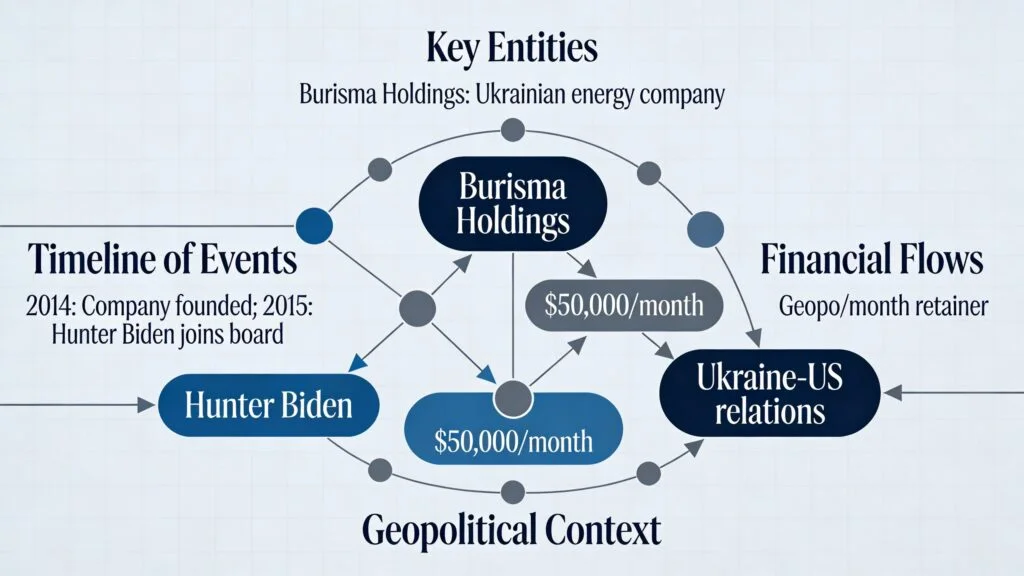
Standards of Evidence Summary for This Article
| Claim | Source | Tier |
|---|---|---|
| Hunter Biden Burisma board membership and compensation | Senate Finance Committee Report, 2020 | Tier 1 |
| Rosemont Seneca Partners co-founders | Senate Finance Committee Report, 2020 | Tier 1 |
| Biden CFR remarks on loan guarantee conditionality | CFR.org official transcript, 2018 | Tier 1 |
| PrivatBank nationalization and capital shortfall | National Bank of Ukraine, IMF, 2016 | Tier 1 |
| Kolomoisky DOJ indictment | DOJ Press Release and Indictment, 2023 | Tier 1 |
| Devon Archer fraud conviction | Second Circuit Court of Appeals, 2022 | Tier 1 |
| FARA enforcement history | DOJ Annual Reports to Congress | Tier 1 |
| Revolving door pattern across administrations | Interior IG Report 2008, Johnson and Kwak 2010 | Tier 1 and Tier 2 |
| Shokin investigation scope at time of removal | Senate Finance Committee Report, pp. 27 to 34 | Tier 2 (disputed in context) |
Full Source List
Primary Documents:
- Senate Finance and Homeland Security Committees, Hunter Biden / Burisma Report, September 2020
- Biden Remarks at Council on Foreign Relations, January 2018
- IMF Ukraine Extended Fund Facility Documentation, 2015 to 2017
- IMF Statement on PrivatBank Nationalization, December 2016
- National Bank of Ukraine, PrivatBank Nationalization Report, 2016
- DOJ Indictment, United States v. Kolomoisky, September 2023
- U.S. v. Archer, Second Circuit Court of Appeals, 2022
- U.S. v. Manafort, Eastern District of Virginia, 2018
- DOJ FARA Statute, 22 U.S.C. 611
- DOJ FARA Annual Report to Congress, 2022
- DOJ FARA Registration Database, Public Search
- Interior Department Inspector General Report, 2008
- U.S. Department of State, U.S. Assistance to Ukraine Overview
Secondary Sources:
Related Analysis on thehiddenhand.net:
- Chapter 2: The Architecture of Institutional Power
- Chapter 4: The Manufactured Crisis Playbook
- Chapter 6: The Management of Dissent
- Appendix A: The Future of Financial Architecture
- Standards of Evidence Rubric
- Why the Architecture of Global Control Is Under Unprecedented Pressure
Book Cross-Reference Notes for the Author
The following sections of The Hidden Hand: Then and Now connect directly to this article and may be worth cross-referencing in the published edition:
Chapter 2 (Revolving Door): The Burisma case is a near-perfect contemporary illustration of the revolving door mechanism described in Chapter 2. Consider adding it as a sidebar case study with a footnote to the Senate Finance Committee report.
Chapter 4 (Foreign Aid as Leverage): The Biden-Shokin-loan guarantee sequence is a textbook example of the foreign aid leverage model. The CFR transcript is a rare instance of a senior official describing the mechanism in their own words on the record. It belongs in Chapter 4 as a primary source anchor.
Appendix A (Banking Architecture): The PrivatBank nationalization and Kolomoisky indictment sequence illustrates how banking architecture functions as both a tool of state capture and, eventually, a vector for accountability. The $5.5 billion related-party lending figure and the DOJ indictment together make a strong Appendix A case study on the lifecycle of captured banking institutions.
Chapter 6 (Accountability Gaps): The FARA enforcement history and the gap between the Senate report’s findings and the absence of FARA prosecutions in the Burisma matter is a strong addition to Chapter 6’s analysis of how accountability mechanisms are structurally undermined. The comparison to the Church Committee and FCIC accountability gaps reinforces the pattern argument.
Tags
Foreign Aid and Geopolitics Tags:
#ForeignAid, #GeopoliticalLeverage, #UkrainePolicy, #IMF, #BrettonWoods, #USAIDLeverage, #LoanGuarantee, #ForeignPolicy, #StateDepartment, #ConditionalLending, #MarshallPlan
Revolving Door Tags:
#RevolvingDoor, #GovernmentAndFinance, #RosemontSeneca, #HunterBiden, #Burisma, #DevonArcher, #ChristopherHeinz, #JohnKerry, #ConflictOfInterest, #13Bankers, #WallStreetRevolve, #MineralsManagement
Banking Architecture Tags:
#PrivatBank, #StateCaptureBank, #Kolomoisky, #RelatedPartyLending, #BankFraud, #MoneyLaundering, #ShellCompanies, #BankNationalization, #FinancialArchitecture, #AppendixA, #BankingCapture
FARA and Accountability Tags:
#FARA, #ForeignAgentsRegistration, #FARAEnforcement, #AccountabilityGap, #DOJDatabase, #Manafort, #ForeignInfluence, #LobbyingTransparency, #ForeignPrincipal, #SelectiveProsecution
Structural Analysis Tags:
#StructuralLiteracy, #PrimarySourceResearch, #TierOneEvidence, #DeclassifiedDocuments, #SenateReport, #DocumentedRecord, #PatternRecognition, #NotPartisan, #BipartisanPattern, #FollowTheStructure