
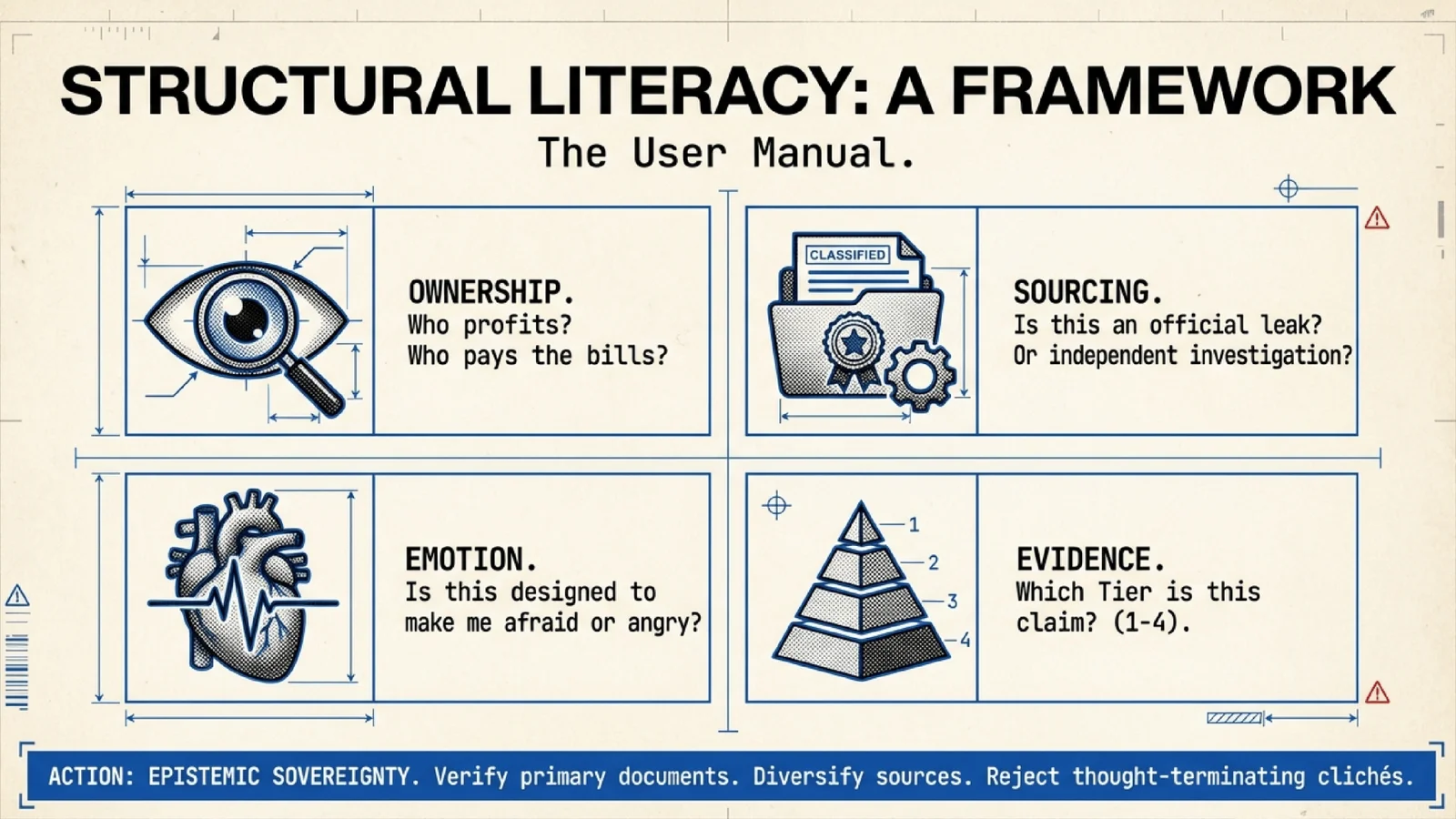
Most people are not uninformed. They are disoriented.
They have access to more information than any previous generation in human history. They can pull up a congressional hearing on their phone, read a declassified document in seconds, and access academic research that would have required a university library thirty years ago.
And yet the sense of confusion, powerlessness, and manipulation has never been more widespread.
The problem is not the quantity of information. It is the absence of a framework for reading it.
That framework has a name. It is called structural literacy. And it is the single most important cognitive skill for navigating the world as it actually operates.
Part One: The Disorientation Problem
Why Smart People Get It Wrong
Disorientation is not a failure of intelligence. It is a predictable response to a specific kind of information environment.
When events are presented as isolated incidents rather than connected patterns, when leaders are framed as heroes or villains rather than as actors within systems, and when complexity is consistently reduced to personality, the natural human response is to focus on the individual rather than the structure.
This is not accidental.
The Powell Memo of 1971, a confidential document written by corporate attorney Lewis Powell to the U.S. Chamber of Commerce, explicitly identified the need to shape how Americans understood economic and political events. It recommended systematic investment in think tanks, academic chairs, media relationships, and legal advocacy to ensure that the dominant public narrative favored a particular set of institutional interests.
Within a decade, the Heritage Foundation, the Cato Institute, and the American Enterprise Institute were all funded and operational.
The memo did not call for manufacturing lies. It called for shaping the framework through which facts would be interpreted.
That is a structural intervention. And it worked precisely because most people were not reading at the structural level.
Source: The Powell Memo, August 23, 1971. Available via Washington and Lee University archives. Tier 1.
The Villain Trap
The most common error in political and social analysis is what might be called the villain trap. It is the assumption that bad outcomes require bad actors, that injustice requires malice, and that reform therefore requires replacing the people at the top.
This assumption is not just wrong. It is strategically disabling.
Consider the 2008 financial crisis. The Financial Crisis Inquiry Commission, established by Congress to investigate its causes, concluded in its 2011 report that the crisis was the result of human action and inaction. It identified failures of regulation, risk management, corporate governance, and oversight across dozens of institutions simultaneously.
No single villain caused the crisis. The system produced it.
And when the crisis passed, the same system remained. The six largest banks in the United States controlled a larger share of total banking assets after the crisis than before it. The regulatory reforms that followed were substantially weakened through lobbying before they were fully implemented.
Replacing the individuals at the top of those institutions would not have changed the outcome. The incentive structure would have produced the same behavior from different people.
That is what structural analysis reveals. And it is what the villain trap prevents you from seeing.
Source: Financial Crisis Inquiry Commission Final Report, 2011. Federal Reserve concentration data. Tier 1.

Part Two: What Structural Literacy Is and Is Not
The Precise Definition
Structural literacy is the ability to read how incentive systems produce outcomes independent of the intentions of the individuals operating within them.
It is not:
- Cynicism about all institutions
- The assumption that every outcome is planned
- A license to dismiss individual moral responsibility
- A conspiracy framework applied universally
It is:
- The recognition that systems reward specific behaviors and punish others
- The understanding that people reliably adapt their behavior to match those rewards
- The ability to trace outcomes back to the incentive structures that produced them
- The skill of asking not just who did this but what system made this the rational choice
The Incentive Principle
The foundational insight of structural literacy is simple: people respond to incentives. Not always consciously. Not always cynically. But reliably.
When a pharmaceutical company’s revenue depends on ongoing treatment rather than cure, the incentive structure points toward chronic disease management rather than resolution. This does not require a boardroom conspiracy. It requires only that the company respond rationally to its financial architecture.
When a regulatory agency’s senior staff rotate between the agency and the industry it regulates, the incentive structure produces regulatory capture. This does not require corruption in the traditional sense. It requires only that people maintain relationships with the communities they will return to.
When a media organization’s revenue depends on advertising from large corporations, the incentive structure produces editorial caution around stories that threaten those corporations. This does not require a phone call from an advertiser. It requires only that editors understand, consciously or not, where the boundaries of acceptable coverage lie.
None of these outcomes require villains. All of them require structural analysis to understand and address.
Why This Is Not Cynicism
Cynicism says: the system is corrupt, nothing can be changed, all actors are self-serving, resistance is futile.
Structural literacy says: the system produces predictable outcomes through identifiable mechanisms, those mechanisms can be mapped, and mapped mechanisms can be targeted for intervention.
These are opposite positions. Cynicism is paralyzing. Structural literacy is activating.
The difference is precision. Cynicism is a feeling. Structural literacy is a tool.
Part Three: Why This Knowledge Is Rare
The Threat to Every Narrative
Structural literacy is politically inconvenient across the entire spectrum of opinion. This is one of the reasons it is rarely taught and rarely rewarded in public discourse.
For those on the political right, structural analysis of corporate power, regulatory capture, and financial concentration is uncomfortable. It implicates institutions and interests that align with conservative economic priorities.
For those on the political left, structural analysis of bureaucratic capture, institutional inertia, and the failure of top-down reform is equally uncomfortable. It implicates the mechanisms through which progressive policy is typically pursued.
For the political center, structural analysis of how consensus is manufactured, how the Overton Window is managed, and how bipartisan agreement often reflects shared institutional interests rather than shared public values is the most uncomfortable of all.
Structural literacy does not flatter any tribe. It dissolves easy blame and exposes continuities that cross partisan lines.
This is precisely why it is valuable. And precisely why it is rare.
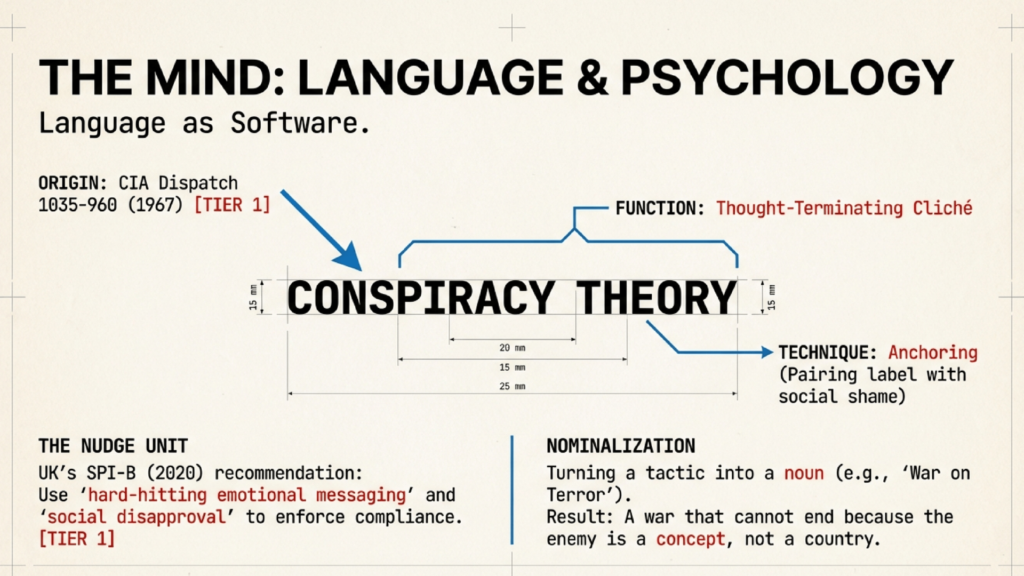
The Education Gap
The American educational system does not teach structural analysis as a core skill. Civics education focuses on the formal mechanics of government: how a bill becomes a law, the separation of powers, the role of the judiciary.
It does not teach how lobbying shapes legislation before it is written. It does not teach how regulatory agencies are captured by the industries they oversee. It does not teach how financial architecture determines policy options before elected officials ever vote.
This is not a conspiracy. It is a curriculum design choice with structural consequences.
Students who graduate without structural literacy are not equipped to read the system they are entering. They are equipped to participate in its formal rituals while remaining largely blind to its actual operating mechanisms.
The Church Committee findings of 1975 documented fifty years of domestic surveillance, propaganda, and covert influence operations conducted against American citizens. These findings are public record. They are available in any library. They are not a standard part of the American high school curriculum.
Source: Church Committee Final Report, 1976. U.S. Senate. Tier 1.
The Complexity Shield
Structural systems are deliberately complex. This is not always intentional obfuscation, but complexity functions as a shield regardless of intent.
When the Federal Reserve’s monetary policy decisions require a graduate degree in economics to evaluate, public accountability becomes practically impossible. When financial derivatives are structured in ways that their own creators cannot fully model, regulatory oversight becomes practically impossible. When legislation runs to thousands of pages and is passed before members of Congress have read it, democratic deliberation becomes practically impossible.
Complexity is not neutral. It concentrates power in the hands of those who can navigate it and removes accountability from those who cannot.
Structural literacy does not require mastering every technical detail. It requires understanding which questions to ask, where the incentives point, and who benefits from the complexity remaining impenetrable.
Part Four: The Documented Pressure Points
Where Intervention Actually Works
The most important practical insight of structural literacy is that not all points in a system are equally susceptible to change. Most are highly resistant. A few are highly vulnerable.
These vulnerable points are called leverage points. Identifying them is the difference between effective advocacy and performative activism.
Systems theorist Donella Meadows identified twelve leverage points in complex systems, ranked by their effectiveness. The most powerful are not the ones that receive the most attention.
Changing the numbers in a system, adjusting a tax rate, modifying a regulation, replacing a leader, is the least powerful form of intervention. The system absorbs these changes and continues producing the same outcomes.
Changing the rules of the system, the incentive structures, the feedback loops, the information flows, is significantly more powerful. This is where structural literacy points.
Changing the goals of the system, what it is designed to optimize for, is the most powerful intervention of all.
Source: Donella Meadows, Thinking in Systems, 2008. Tier 3.
The Four Pressure Points
Based on the documented record of successful structural reform, four pressure points consistently produce durable change:
Transparency
Sunlight is the oldest and most reliable disinfectant. The Freedom of Information Act, passed in 1966 and strengthened in 1974 following Watergate, has produced more accountability than any single piece of reform legislation in American history. The declassified documents that form the evidentiary backbone of structural analysis, the Church Committee findings, Operation Northwoods, CIA Dispatch 1035-960, the Powell Memo, exist because transparency mechanisms forced their release.
Transparency does not fix systems. It makes fixing them possible.
Decentralization
Concentrated power is fragile in one sense and resilient in another. It is fragile because a single point of failure can collapse the entire structure. It is resilient because it can resist reform from any single direction.
Decentralization distributes both the risk and the accountability. When financial power is concentrated in six institutions, the failure of any one threatens the entire system and the political cost of allowing failure becomes prohibitive. When financial power is distributed across hundreds of institutions, failure is contained and accountability is maintained.
The documented history of antitrust enforcement in the United States shows that decentralization works when it is applied. The breakup of Standard Oil in 1911 produced a more competitive energy sector for decades. The failure to apply similar logic to financial institutions in the decades preceding 2008 produced the conditions for systemic collapse.
Accountability
Accountability requires three elements that are frequently present individually but rarely present simultaneously: transparency about what happened, consequences for those responsible, and structural changes that prevent recurrence.
The Church Committee is the clearest example of accountability functioning as intended. It documented abuses, named responsible parties, produced legislative reforms including the Foreign Intelligence Surveillance Act, and established the permanent intelligence oversight committees that exist today.
It did not eliminate intelligence abuses. But it established a framework that made future abuses harder and more costly.
That is what accountability looks like at the structural level. Not punishment as an end in itself, but changed incentives as the goal.
Parallel Institutions
When existing institutions are too captured to reform from within, parallel institutions that model different incentive structures create competitive pressure for change.
The credit union movement created parallel financial institutions that operated on cooperative rather than shareholder-return principles. Community development financial institutions created parallel lending structures that served populations the mainstream financial system ignored. Independent media organizations created parallel information structures that covered stories the captured mainstream media would not.
None of these parallel institutions replaced the dominant structures. All of them changed the competitive landscape and demonstrated that alternative models were viable.
Part Five: From Awareness to Action
The Literacy to Agency Pipeline
Structural literacy is not an end state. It is a starting point. The pipeline from awareness to effective action runs through a specific sequence:
Step 1: Map the incentive structure.
Before analyzing any institution, policy, or event, ask: what does this system reward? What does it punish? Who benefits from the current configuration?
Step 2: Identify the feedback loops.
How does the system correct itself? What happens when it produces bad outcomes? Are the feedback loops functioning or have they been captured?
Step 3: Locate the leverage points.
Where in this system is change most possible? Where is it least possible? What has worked historically in similar systems?
Step 4: Assess the cost of intervention.
Every leverage point has defenders. Who benefits from the current structure and what resources will they deploy to maintain it?
Step 5: Choose the pressure point.
Transparency, decentralization, accountability, or parallel institution. Which is most accessible given current conditions?
Step 6: Act with precision.
Unfocused pressure dissipates. Focused pressure at the right leverage point produces disproportionate results.
The Difference Between Protest and Pressure
Protest is visible. Pressure is effective. They are not the same thing.
Protest changes the public narrative. It shifts the Overton Window. It signals the existence of a constituency for change. These are not trivial functions. But protest alone does not change incentive structures.
Pressure targets specific leverage points with specific demands and specific consequences for non-compliance. It requires structural literacy to identify the leverage point, organizational capacity to sustain the pressure, and strategic clarity about what success looks like.
The civil rights movement succeeded not because it generated visible protest, though it did, but because it combined protest with legal strategy, economic pressure, and political organization targeted at specific structural leverage points. The Voting Rights Act of 1965 was not the result of moral persuasion alone. It was the result of sustained, structurally literate pressure applied at the precise points where the system was most vulnerable.
That is structural literacy translated into action.
Part Six: The Hard Constraint
There is one principle that structural analysis returns to consistently:
You cannot dismantle what you do not understand.
This is not a metaphor. It is a practical constraint.
Reform efforts that do not account for the incentive structures they are trying to change will be absorbed by those structures. The history of regulatory reform is largely a history of well-intentioned interventions that were captured, weakened, or reversed because the reformers did not fully understand the system they were entering.
The Dodd-Frank Act was the most comprehensive financial reform legislation since the New Deal. It was substantially weakened before it was fully implemented, not through dramatic opposition, but through the patient, structurally literate lobbying of the institutions it was designed to regulate.
The reformers had moral clarity. The institutions had structural literacy. The institutions won.
This is the argument for structural literacy as a civic priority. Not because it guarantees success. But because without it, failure is nearly certain.
Part Seven: Why This Is the Beginning, Not the End
Structural literacy does not produce despair. It produces precision.
The person who understands how incentive structures produce outcomes is not more cynical than the person who does not. They are more effective. They know where to push. They know what to expect. They know when they are winning and when they are being absorbed.
They are also harder to manipulate through fear, harder to redirect through false villains, and harder to exhaust through performative battles at the wrong leverage points.
Prepared citizens who read at the structural level are, as the documented record consistently shows, the most durable force for accountability that any system faces.
Structural literacy is not the end of the journey.
It is the beginning of effective resistance.
Sources and Evidence Tier
| Claim | Source | Tier |
|---|---|---|
| Powell Memo content and outcomes | Washington and Lee University archives, 1971 | Tier 1 |
| 2008 crisis was avoidable | Financial Crisis Inquiry Commission, 2011 | Tier 1 |
| Six banks post-crisis concentration | Federal Reserve / FDIC data | Tier 1 |
| Church Committee findings | Church Committee Final Report, 1976 | Tier 1 |
| FOIA history and impact | National Security Archive documentation | Tier 1 |
| Standard Oil breakup outcomes | Federal antitrust records, 1911 | Tier 1 |
| Leverage points in systems | Donella Meadows, Thinking in Systems, 2008 | Tier 3 |
| Voting Rights Act legislative history | Congressional Record, 1965 | Tier 1 |
| Dodd-Frank weakening | Congressional Research Service reports | Tier 1 |
This article is adapted from themes in “The Hidden Hand: Then and Now: Pattern Language of Modern Power” by Steafon Perry, available March 18, 2026 on Google Play Books.