A Free Guide From the Author of The Hidden Hand: Then and Now
By Steafon Perry
Every morning, millions of people scroll through headlines and feel one of two things: confused or outraged. Rarely informed.
That is not an accident.
The Hidden Hand: Then and Now spent hundreds of pages documenting how concentrated power operates through documented, verifiable patterns. Institutional capture. Regulatory revolving doors. Narrative framing. These are not theories. They are techniques with paper trails.
But a book is a commitment. A headline is three seconds.
So here is the problem: the same structural patterns that took a full manuscript to document are operating in the time it takes you to read a push notification. And most readers have no framework for catching them in real time.
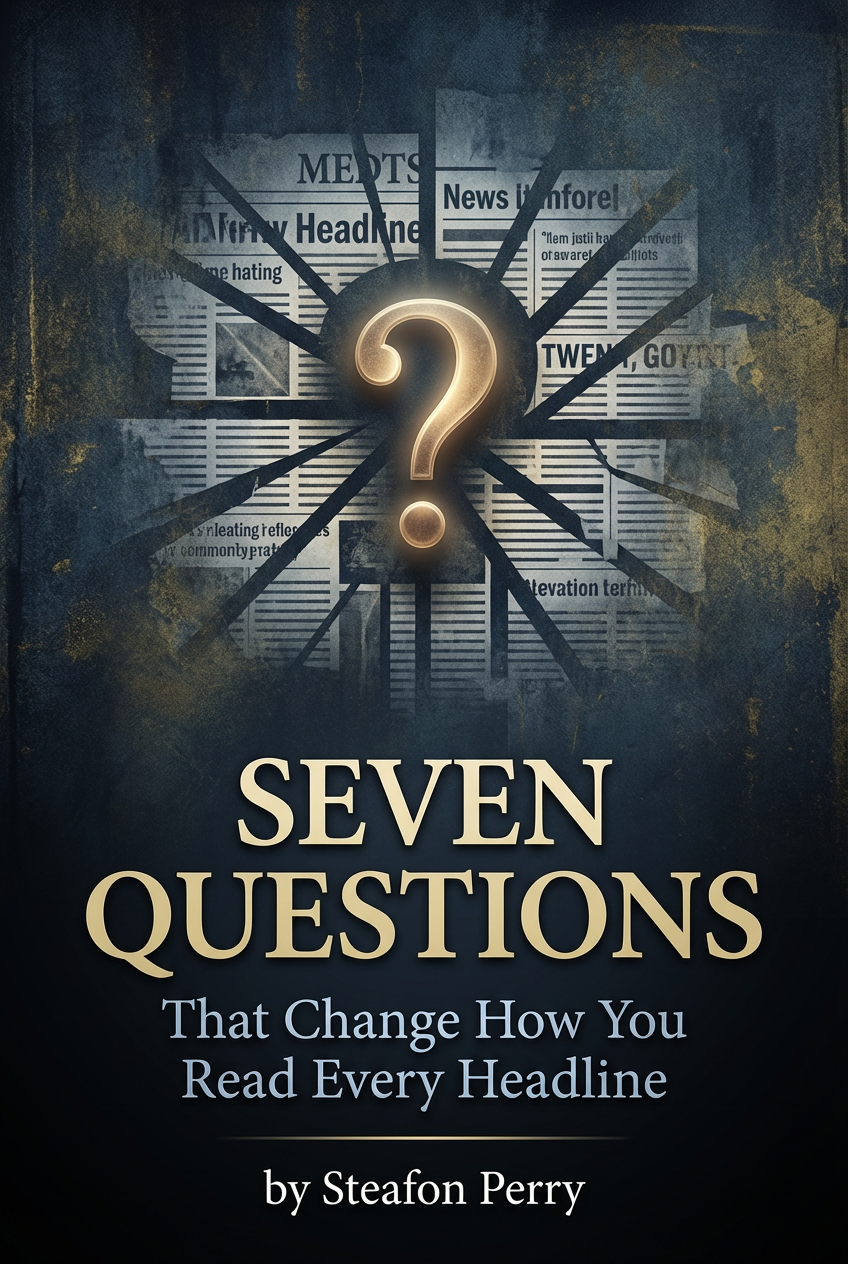
That is why I wrote Seven Questions That Change How You Read Every Headline.
What This Free Guide Actually Does
This is not a media literacy pamphlet. It is not a list of “trusted sources.” It is a portable analytical framework, drawn directly from the research behind The Hidden Hand, compressed into seven questions you can apply to any headline, any story, any platform, in under sixty seconds.
Each question targets a specific structural pattern documented in the book:
Question 1: Who benefits from this story being told right now?
Timing is rarely neutral. The Church Committee findings, the Powell Memo, and dozens of other documented cases show that information release is often strategic. This question trains you to look at the calendar, not just the content.
Question 2: What is the story not naming?
Omission is the most powerful editorial tool available. When a headline says “markets fell today,” it is choosing not to say who sold, who bought, and who knew first. This question restores what framing removes.
Question 3: Who is being positioned as the cause, and who is being protected as the system?
This is the structural versus scapegoat distinction at the heart of The Hidden Hand. Individuals get named. Institutions get passive voice. This question flips that.
Question 4: What would have to be true for this story to be wrong?
This is the falsifiability test. If a narrative cannot be challenged by any conceivable evidence, it is not journalism. It is positioning. This question separates analysis from advocacy.
Question 5: Where does the money flow after this story lands?
Policy follows narrative. Narrative follows interest. The Financial Crisis Inquiry Commission documented this in granular detail. This question connects the headline to the downstream transaction.
Question 6: Has this pattern appeared before, and what happened next?
The Hidden Hand is built on Then and Now parallels for a reason. History does not repeat exactly, but structural playbooks do. This question activates pattern recognition rather than event-by-event reaction.
Question 7: What action is this story designed to make you take, or avoid?
Every piece of mass communication has a behavioral target. Fear drives avoidance. Outrage drives sharing. Helplessness drives disengagement. This question identifies the intended response so you can choose your own.
Why These Seven Questions, Specifically
These are not random critical thinking prompts. Each one maps directly to a documented mechanism in The Hidden Hand: Then and Now.
The book traces how the same structural patterns that operated in the early twentieth century, through institutional capture, coordinated narrative, and financial leverage, are operating today through different actors, different platforms, and different vocabulary.
The seven questions are the portable version of that analysis. They do not tell you what to think. They change how you think, which is a different thing entirely.

Who This Guide Is For
This guide is for the reader who is done being outraged and wants to be accurate instead.
It is for the professional who needs to brief colleagues on a developing story without getting caught flat-footed by a narrative that shifts three days later.
It is for the student who has been told to “check multiple sources” but was never given a framework for evaluating what those sources are actually doing.
It is for the parent who wants to teach their teenager something more useful than “don’t believe everything you read.”
It is for anyone who finished The Hidden Hand: Then and Now and asked: now what do I do with this on a Tuesday morning?”
What You Get When You Download
The free guide includes:
- All seven questions with full explanations and real-world application examples
- A one-page quick-reference card you can print or save to your phone
- Three worked examples applying the framework to actual headline categories: political news, financial news, and international conflict coverage
- A direct connection to the Standards of Evidence Rubric from The Hidden Hand, so you understand the evidentiary bar behind each question
- A note on what the framework cannot do, because intellectual honesty about limitations is part of the methodology
A Note on What This Is Not
This guide does not tell you which outlets to trust. It does not have a political orientation. It does not ask you to be suspicious of everything or credulous about anything.
It asks you to apply the same standard to every story: documented evidence, named sources, falsifiable claims, and structural analysis over individual blame.
That standard is not partisan. It is the same standard used by the Church Committee, the Financial Crisis Inquiry Commission, and every serious investigative body that has ever produced findings that held up over time.
Download the Free Guide
Seven Questions That Change How You Read Every Headline is available free when you join the reader community for The Hidden Hand: Then and Now.
You will also receive updates on the ongoing research, new Then and Now parallels as they emerge in current events, and early access to future work.
The playbook was never secret. It was just never read.
Now you have the questions to find it in real time.
Steafon Perry is the author of The Hidden Hand: Then and Now: Pattern Language of Modern Power. The book applies a documented Standards of Evidence Rubric to the structural patterns of concentrated power across a century of verifiable history.