
Here Is Why That Is a Structural Story, Not a Financial One
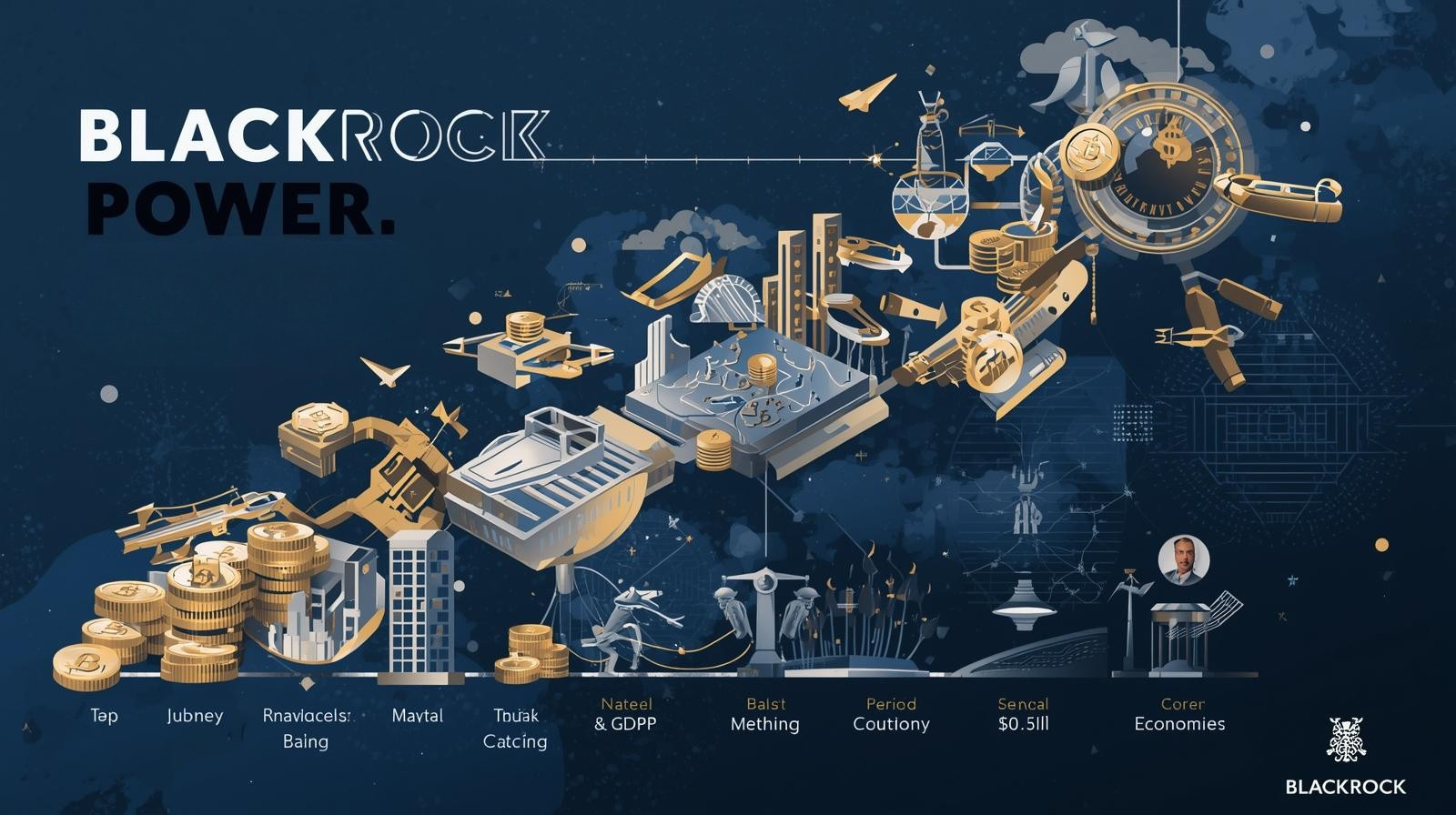
The number gets cited often enough that it has lost its weight. BlackRock manages approximately $10 trillion in assets. That figure exceeds the GDP of every nation on earth except the United States and China. It exceeds the combined GDP of Germany, Japan, India, and the United Kingdom. It is not a financial statistic. It is a governance statistic.
Here is what that distinction means in practice.
What asset management actually is:
When BlackRock manages your pension fund, your index fund, or your sovereign wealth allocation, it does not simply hold your money. It votes your shares. Every publicly traded company in which BlackRock holds a position receives a proxy vote from BlackRock on matters of corporate governance board composition, executive compensation, merger approvals, environmental policy, and shareholder resolutions. At $10 trillion in assets under management, BlackRock is frequently the largest single shareholder in the most consequential companies on earth simultaneously.
That means BlackRock holds significant voting positions in Apple, Microsoft, Amazon, JPMorgan Chase, ExxonMobil, and Bank of America, often at the same time. It is not a competitor to these companies. It is a cross-cutting governance node that sits above the competitive layer entirely.
The index fund mechanism:
Much of BlackRock’s growth has been driven by the rise of passive index investing. When you buy an S&P 500 index fund, you are not picking stocks. You are buying a proportional slice of every company in the index, weighted by market capitalization. BlackRock’s iShares product line is the dominant provider of these instruments globally.
The structural consequence is this: as more capital flows into passive index funds, more voting power concentrates in the hands of the fund manager of BlackRock, Vanguard, and State Street, the so-called Big Three. A 2017 study published in the Journal of Finance found that the Big Three collectively held an average of 20 percent of shares in S&P 500 companies. That figure has grown since. The researchers described this as the rise of a “new permanent universal owner,” an entity with stakes in every major company, in every major sector, with no competitive incentive to favor one over another and every structural incentive to favor stability, incumbency, and the status quo.
The Aladdin system:
BlackRock’s risk management platform, known as Aladdin (Asset, Liability, Debt, and Derivative Investment Network), processes data on approximately $21.6 trillion in assets, including assets managed by other institutions that license the platform. Central banks, sovereign wealth funds, insurance companies, and pension managers use Aladdin to model risk. The Federal Reserve used BlackRock’s services during the 2020 COVID-19 market intervention to manage bond-buying programs.
That arrangement as a private asset manager operating infrastructure for a central bank’s emergency market intervention is not a conspiracy. It is a procurement decision. But it is a structural fact worth understanding: the same firm that manages the assets also models the risk for the institutions regulating those assets. That is a concentration of informational and operational power with no clear historical precedent.
The revolving door:
BlackRock’s leadership has included former officials from the U.S. Treasury, the Federal Reserve, the European Central Bank, and the International Monetary Fund. Its founder and CEO Larry Fink has been a consistent presence at Davos, at G7 finance minister meetings, and in direct communication with heads of state during financial crises. This is not unusual for a firm of this scale. It is, however, a data point in the structural pattern: the boundary between private asset management and public financial governance has become functionally porous.
Why this is a pattern story, not a villain story:
BlackRock did not seize power. It grew into a structural position that the architecture of modern finance made possible and, in some respects, inevitable. The rise of passive investing, the deregulation of financial services, the outsourcing of government risk management to private contractors, and the concentration of institutional capital in a small number of index providers all contributed to the current configuration.
The pattern is not unique to BlackRock. It is the same pattern documented in the Powell Memo’s call for coordinated corporate influence over academic, judicial, and political institutions. It is the same pattern visible in the post-Glass-Steagall consolidation of commercial and investment banking. The mechanism changes. The structural outcome and concentration of decision-making power in a small number of private hands remains consistent.
That is the story. The $10 trillion is just the headline.
Primary Sources and Further Reading:
- BlackRock 2024 Annual Report
- Bebchuk, L. and Hirst, S. “The Specter of the Giant Three.” Boston University Law Review, 2019
- Fichtner, J., Heemskerk, E., and Garcia-Bernardo, J. “Hidden Power of the Big Three.” Business and Politics, 2017
- Federal Reserve Bank of New York: BlackRock COVID-19 Mandate Documentation, 2020
- Powell Memo, 1971, U.S. Chamber of Commerce Archive
- OpenSecrets: BlackRock Lobbying Data